Why a clear door slips past attention
Seeing is not the same as carefully inspecting everything in view. The brain receives far more visual detail than it can consciously examine, so attention selects what seems useful for the task at hand. If you are looking for an exit or watching someone approach, those goals can take priority over checking whether the open-looking space is actually clear.
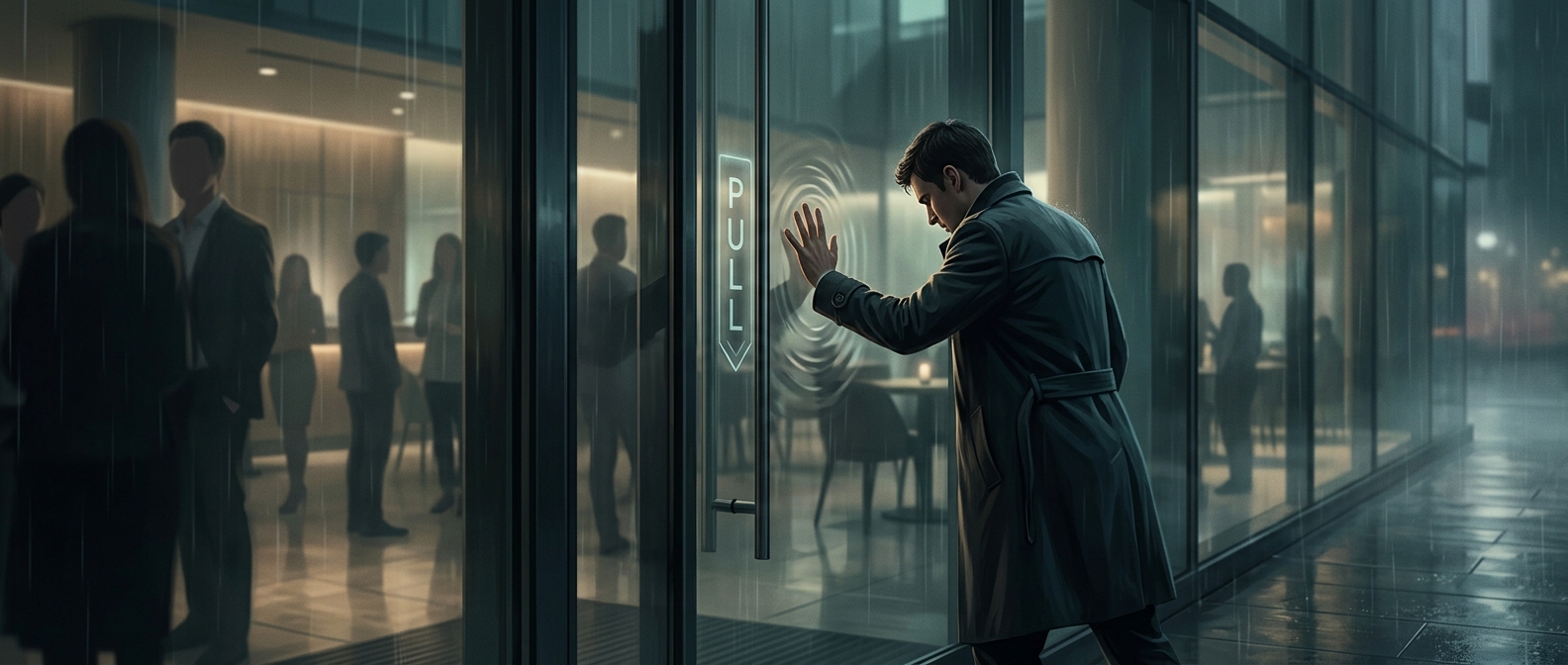
A transparent door makes that selection easier to get wrong. It lets the scene beyond it remain visible, while a faint frame or handle offers little contrast to mark the glass as an object. The destination is visually prominent; the barrier is not.
The mind commits before the body arrives
Movement adds a timing problem. As you walk, your brain uses the scene to guide the next step, relying on familiar cues and predictions about what lies ahead. When the doorway appears to continue into the hall, your movement can already be organized around passing through before attention registers the pane.
This is a form of inattentional blindness: a noticeable thing goes unnoticed because attention is occupied elsewhere. It does not mean the eyes failed to receive the light from the glass. Rather, the glass did not become the focus of conscious awareness in time to change the plan.
Small cues can change the reading
A visible frame, handle, decal, or reflection gives the eye evidence that the seemingly open space has a boundary. Without such cues, a clean pane can preserve the view while hiding the very surface that interrupts it. The mistake is a reminder that our perception is shaped not just by what is in front of us, but by what we are trying to do when we look.