Why inverted faces conceal familiar distortions
People do not recognize a face by checking each feature independently. They are especially good at noticing how the eyes, nose, and mouth fit together: their relative positions, spacing, and orientation. Psychologists call this configural processing—reading the arrangement of parts as a pattern.
That skill is tuned to upright faces. Turn a face upside down and its usual arrangement becomes harder to read, so the visual system relies more on the features themselves. A warped expression or oddly positioned eyes may still be visible, but the mismatch among parts is less obvious.
The switch that makes the oddness pop
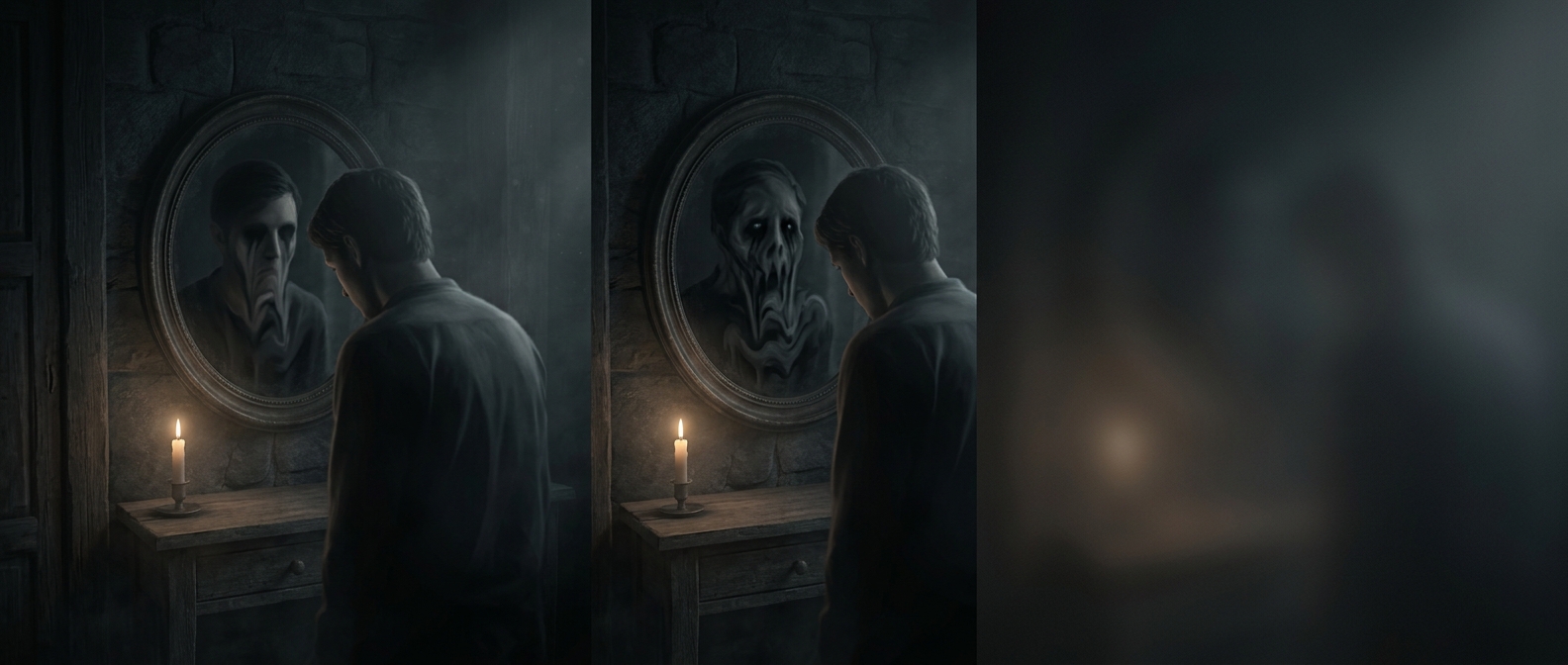
The classic example is the Thatcher illusion. In a photograph, the eyes and mouth are altered—often rotated within the face. When the whole image is upside down, those changes can seem surprisingly ordinary. Rotate the image upright, and the same features suddenly look grotesque.
The changes were present all along. What shifts is how effectively the brain compares them with its expectations for an upright face. Restoring the familiar orientation makes the relationships among the features easier to evaluate, and the distortions stand out.
This is why the effect feels like a transformation rather than a gradual discovery: the image has not changed, but the face has become much easier to interpret as a face. It is a small demonstration of how strongly perception depends on the arrangement of what we see—not just on the pieces themselves.