Why a steady gaze can make features fade
Your eyes are never perfectly still. Even when you try to stare at one point, they make tiny movements that continually shift the image across the retina, the light-sensitive tissue at the back of the eye. Those movements help keep a scene from fading out.
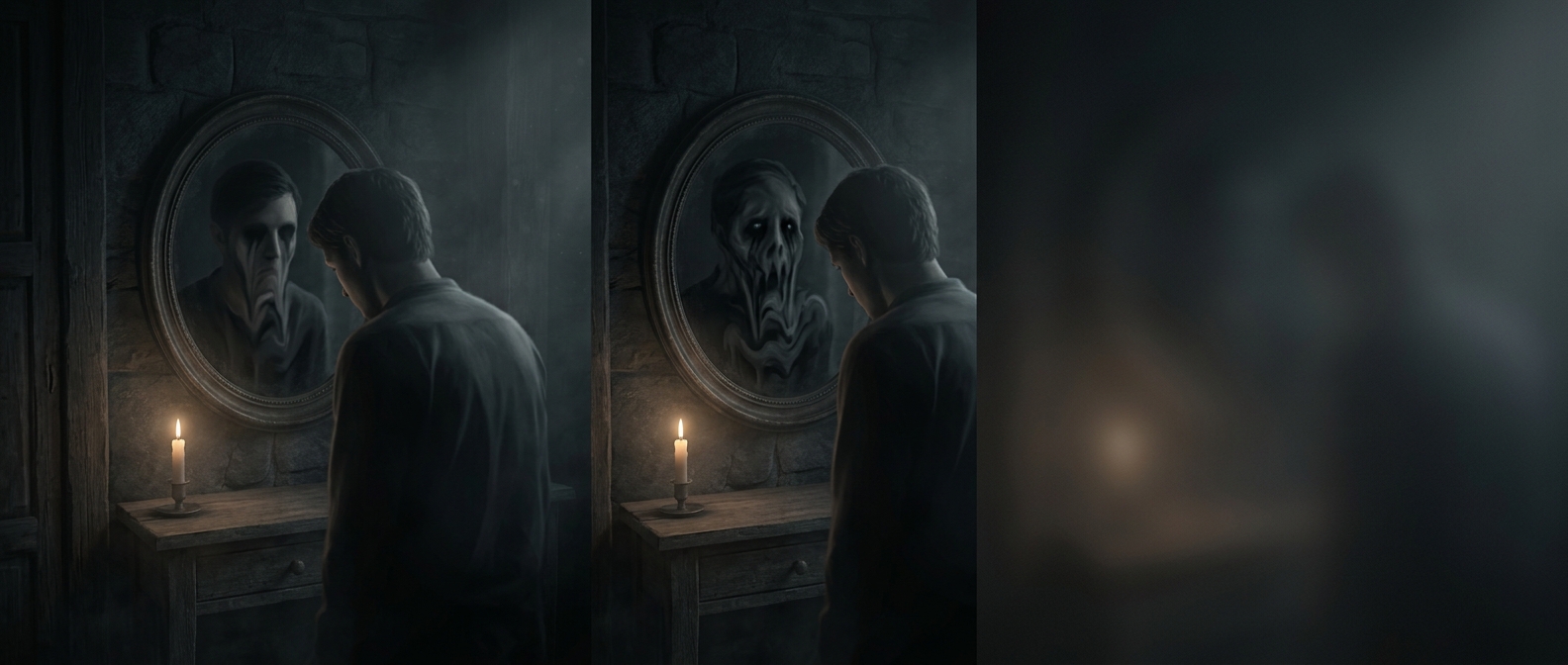
In dim light, the image has less contrast and detail to begin with. If you hold your gaze on one spot in your reflection, parts of the face—especially features away from that spot—may barely change on your retina. Neurons responding to an unchanging signal become less responsive, a basic form of sensory adaptation. The result can be a feature that seems to soften, disappear, or change shape. This is related to Troxler fading, the loss of a steady visual detail during prolonged fixation.
The brain fills in what the eyes no longer supply
Vision is not a camera recording every pixel equally. The brain combines incoming signals with expectations about familiar patterns, including what a face should look like. When the signal is weak or incomplete, that interpretation has more room to shift: a shadow may seem like a changed contour, or a fading feature may be perceptually replaced by a different one.
A face is especially noticeable when it seems wrong because people are highly practiced at detecting faces and small changes in them. But the experience does not mean the reflection itself has altered, or that the brain has stopped seeing altogether. It is a moment when a stable, low-detail image gives the visual system less reliable evidence than usual. Blink, move your eyes, or turn on a light, and the changing retinal image supplies fresh detail—often making the familiar face snap back into place.