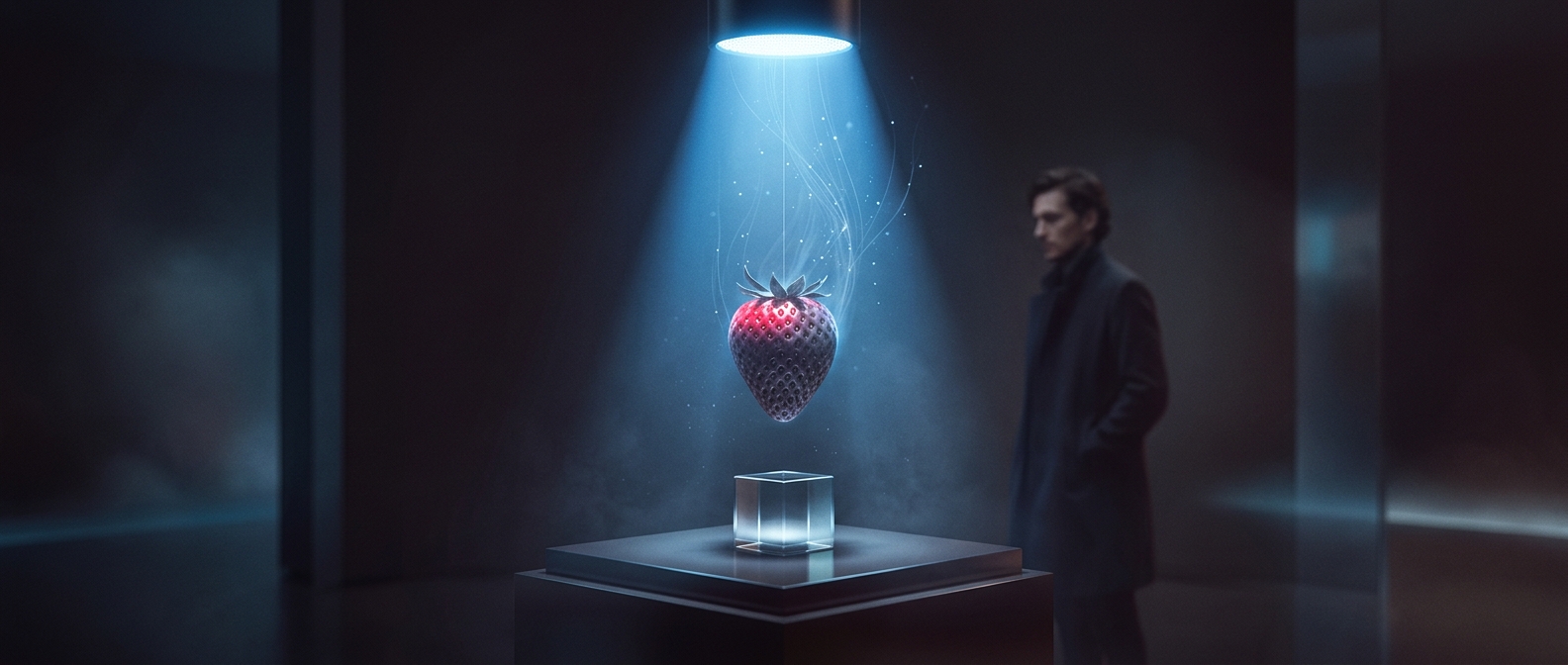
The brain separates lighting from surface color
A strawberry does not send “red” to the eye. Light hits its skin, and the skin reflects some wavelengths more strongly than others. Under blue lighting, the light reaching the berry—and then bouncing toward the eye—has a different mix of wavelengths than it would under daylight. The eye receives that altered signal, not the strawberry’s color in isolation.
Yet people often recognize the berry as red. The visual system tries to estimate which part of the signal comes from the illumination and which part comes from the object’s surface. This ability is called color constancy: the tendency for a surface to look roughly the same color even as the lighting changes.
How the scene supplies clues
The brain cannot measure the lamp directly, so it makes an informed guess from the whole view. It compares neighboring surfaces, notices how light and shadow fall, and draws on familiar patterns—for example, that objects in a scene are being lit by the same source. If the surrounding light appears bluish, the visual system can partly discount that blue cast when interpreting the strawberry.
This is not a deliberate correction. Signals from the eye’s different light-sensitive cells are processed in relation to one another, while later visual processing uses context to settle on the most plausible interpretation. The result is an experience of a red berry rather than a bare report of blue-tinted light.
A useful estimate, not a perfect one
Color constancy works best when the scene offers enough clues about the illumination. A strongly colored light can remove much of the information the eye needs: if almost no red wavelengths reach the strawberry, its reflected light may look very dark, and the brain has less basis for seeing it as red. The same berry can therefore seem red in one blue-lit setting and nearly black in another.
That limit reveals what perception is doing. It is not a camera recording wavelengths unchanged; it is an interpretation that helps objects keep recognizable identities as the light around them shifts.