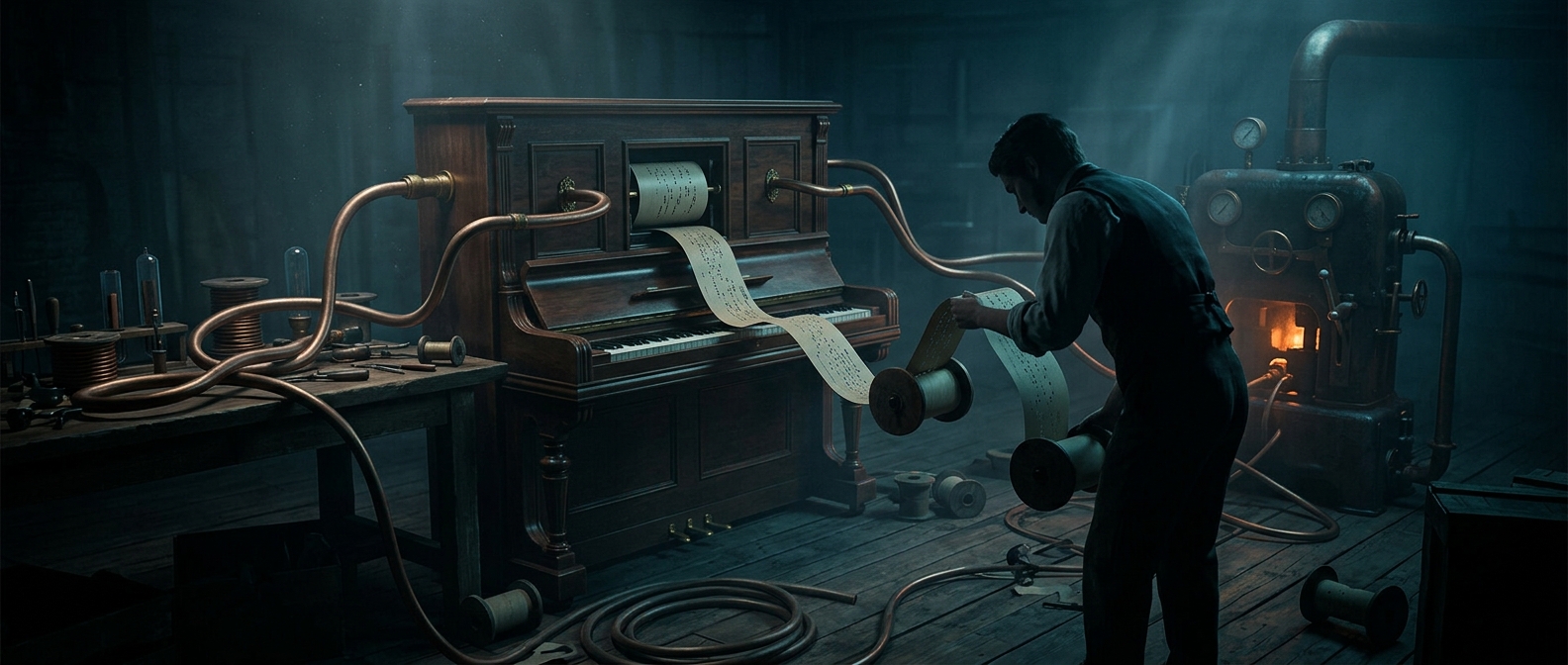
How a paper roll became a performance
A Phonola roll was more than a strip of music notation. Its holes encoded which notes should sound and when. As the paper moved across a row of openings called a tracker bar, each perforation briefly lined up with an opening beneath it. That let air flow through a control system and activate the corresponding piano key.
The result was a chain of small actions: the roll positioned a hole, airflow triggered a mechanism, and a key struck a string. The machine supplied the fingerwork, while the roll supplied the sequence.
The player powered the air
The Phonola was not simply wound up and left to play. The person at the instrument worked foot pedals, much like pumping a harmonium, to create the suction the mechanism needed. Without that steady supply of air, the roll could move but the keys would not be driven in the same way.
That division of labor made the performance possible: paper carried the musical instructions, the pedals powered the mechanism, and the piano produced the sound. A piece by Chopin could therefore be heard without a pianist physically playing each key—but it still depended on a person to keep the machine breathing.