Pac-Man Has No Final Level
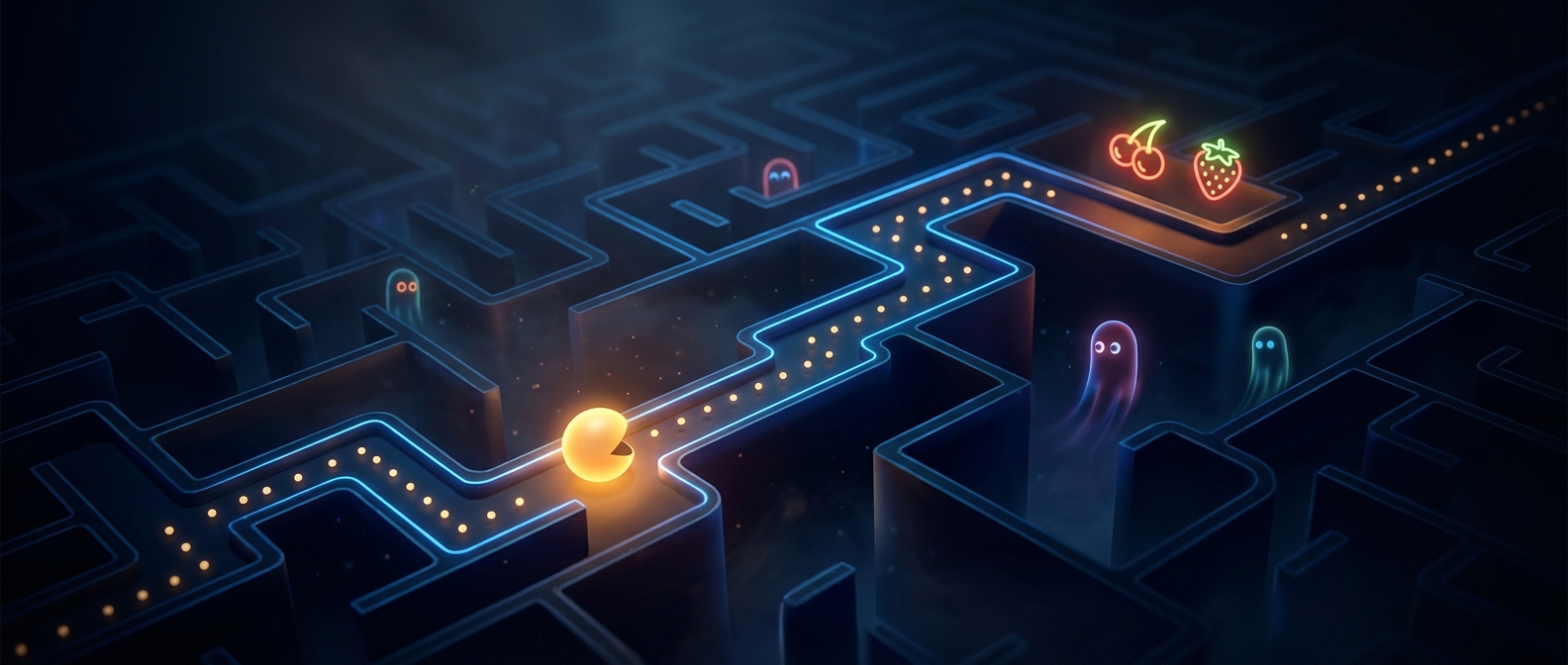
Classic arcade Pac-Man was built as an endless score challenge, not a campaign with a last stage. Each maze cleared sends Pac-Man into another, with no final boss, victory screen, or built-in point at which the game declares that you have won. The difficulty eventually stops rising in the usual way, but the levels keep coming.
That design makes “beating” the game a matter of choosing a stopping point. A player can clear many mazes and rack up a score, but the original arcade game offers no ordinary ending to reach.
The Level 256 Crash
There is, however, a hard limit hidden in the game’s programming. After level 255, the arcade machine reaches level 256, where a famous glitch corrupts much of the maze’s right side. The result—often called the split-screen or kill screen—leaves a board that cannot be completed normally.
The game has not presented a final challenge designed to test the best players. It has run into a technical failure: the routines that draw the maze and handle level-related information do not behave correctly at that point. The left side remains playable, but the corrupted half prevents a normal clear, so the game cannot advance to another level.
A Limit, Not a Victory
Reaching that screen is an extraordinary endurance feat, but it is not the same as winning in the usual sense. The player has not completed a final stage; the program has reached a broken state with no intended ending. Pac-Man’s ultimate “finish line” is a programming boundary, not a victory condition.