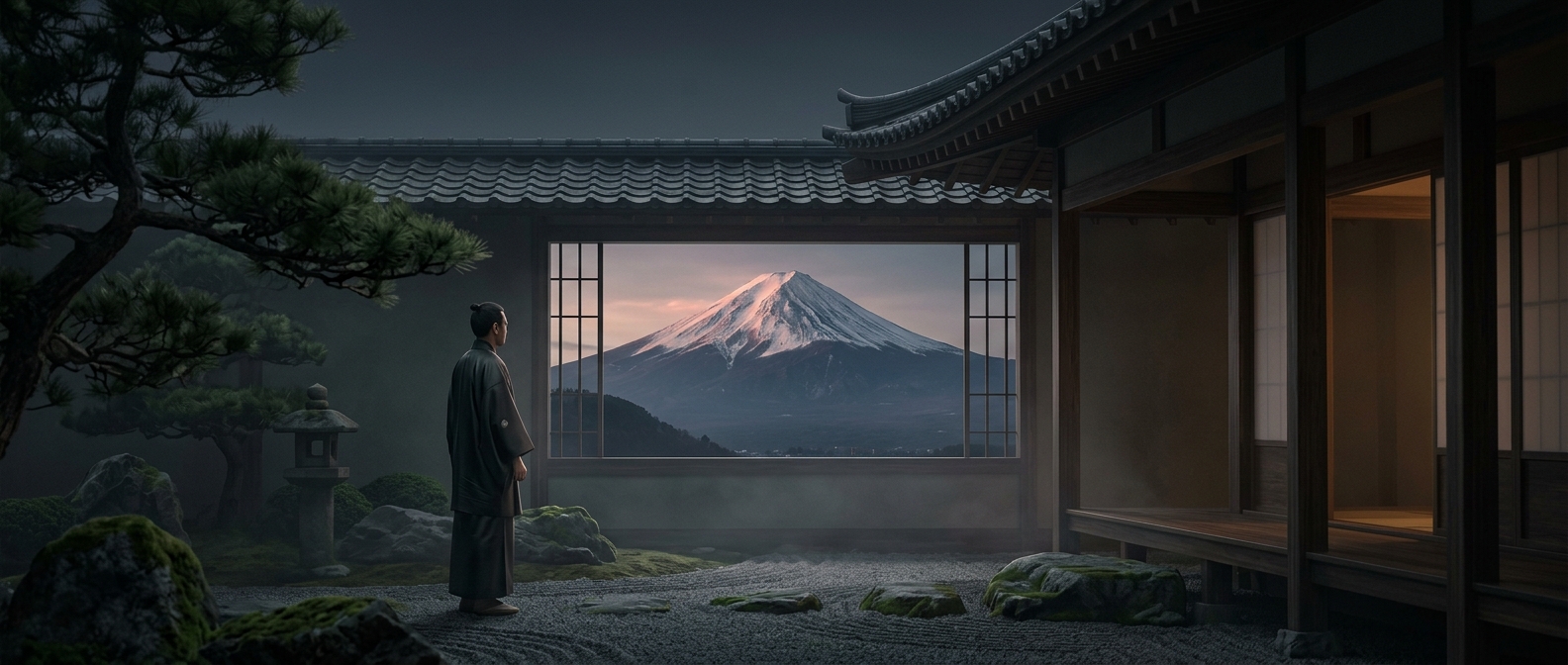
How borrowed scenery extends a garden
Japanese garden designers use a technique known as shakkei, often translated as “borrowed scenery,” to make a designed space feel connected to the landscape beyond it. Instead of treating the garden boundary as the edge of the view, they arrange what is inside it to lead the eye outward—to a mountain, wooded slope, or other distant feature.
The foreground changes the scale
The effect depends on relationships between near and far. A carefully placed tree, pond, path, or opening gives the viewer a foreground to compare with the distant landscape. That contrast helps the eye read the mountain as part of a composed scene rather than as an unrelated backdrop. A gate or gap can also narrow attention, much as a frame does in a painting, while plants can partly conceal boundaries that would otherwise interrupt the view.
Nothing about the mountain has to change. The garden changes the way it is seen: its small, controlled details become the near portion of a much larger composition. The apparent size of the garden expands because the view carries beyond its physical limits.
A view that depends on where you stand
Borrowed scenery is tied to a particular viewpoint. A screen, branch, or opening that aligns the foreground with a distant peak from one spot may not work from another. The arrangement therefore guides not only what visitors see, but where they pause to see it. A garden can feel intimate up close while opening, from a chosen position, onto a landscape far larger than itself.