The tension hidden in a spinning Halo ring
A Halo ring’s spin is what makes its inner surface feel like “down.” As the ring turns, the floor must continually curve beneath everything on it; that motion creates the outward pull people experience as weight. But the same motion strains the ring itself.
Imagine a tiny section of the ring. It wants to fly off along a straight path, so neighboring sections must pull it inward. Each part is held in place by the tension of the material around the whole circumference—like a rubber band being swung in a circle, but on an astronomical scale.
Why the strain grows with the ring
The faster the ring spins, the harder its material must pull to keep each section on its circular path. And a larger ring needs more tension still: to provide the same apparent gravity at a greater radius, its surface has to move faster. The required strength therefore depends not just on the ring’s weight, but on its size and rotation.
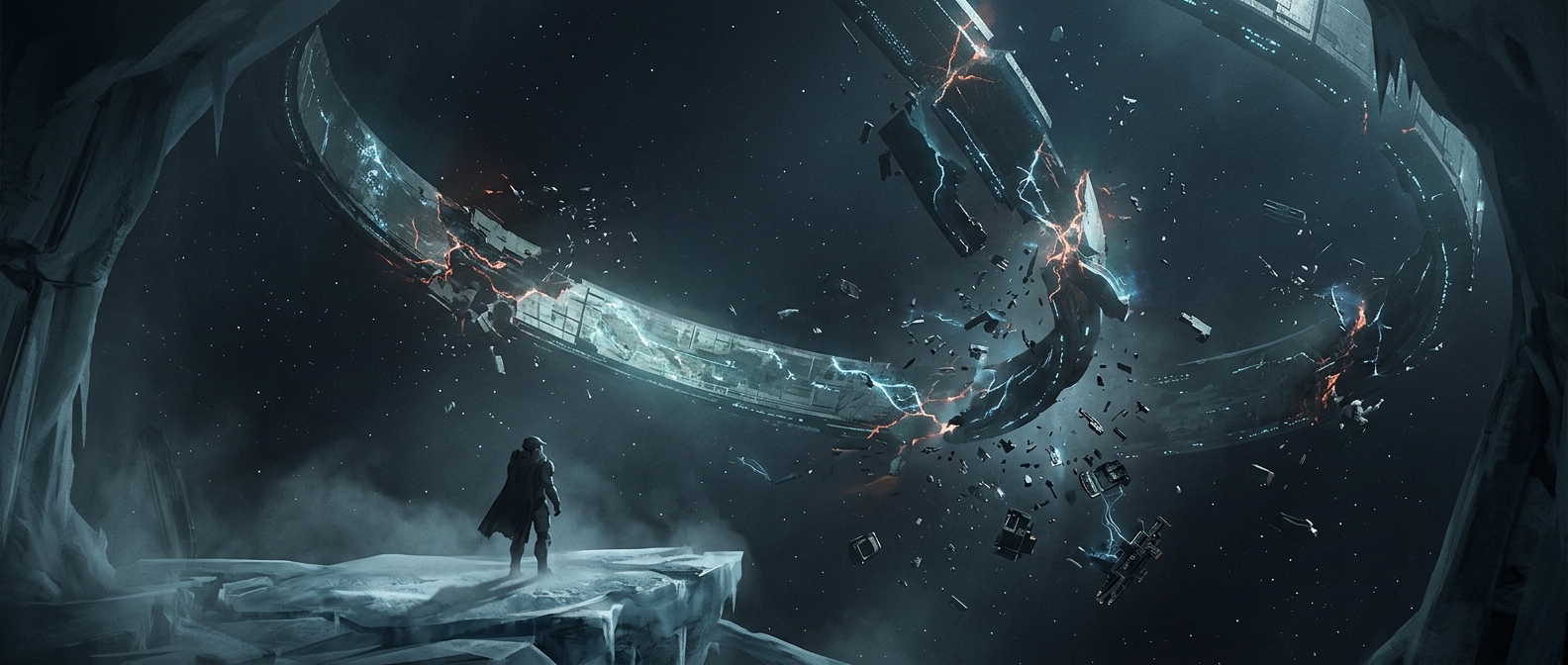
That creates a harsh engineering tradeoff. A ring sturdy enough to hold together might need to spin too slowly to provide useful artificial gravity. Spin it enough to make the inner landscape livable, and the material may be stretched past the point where it can carry the load. A crack would concentrate stress at its edge, making further tearing more likely rather than neatly stopping the damage.
The fictional material problem
Ordinary building materials are nowhere near strong enough for a structure on this scale. Halo’s rings therefore rely on fictional engineering and materials to make their immense, rotating spans possible. The vulnerability is built into the premise: the ring’s motion creates the very conditions that its structure must resist.
That is why a ringworld is more than a giant circular platform. Its entire inhabited surface depends on an unbroken loop of material holding against a relentless outward strain.