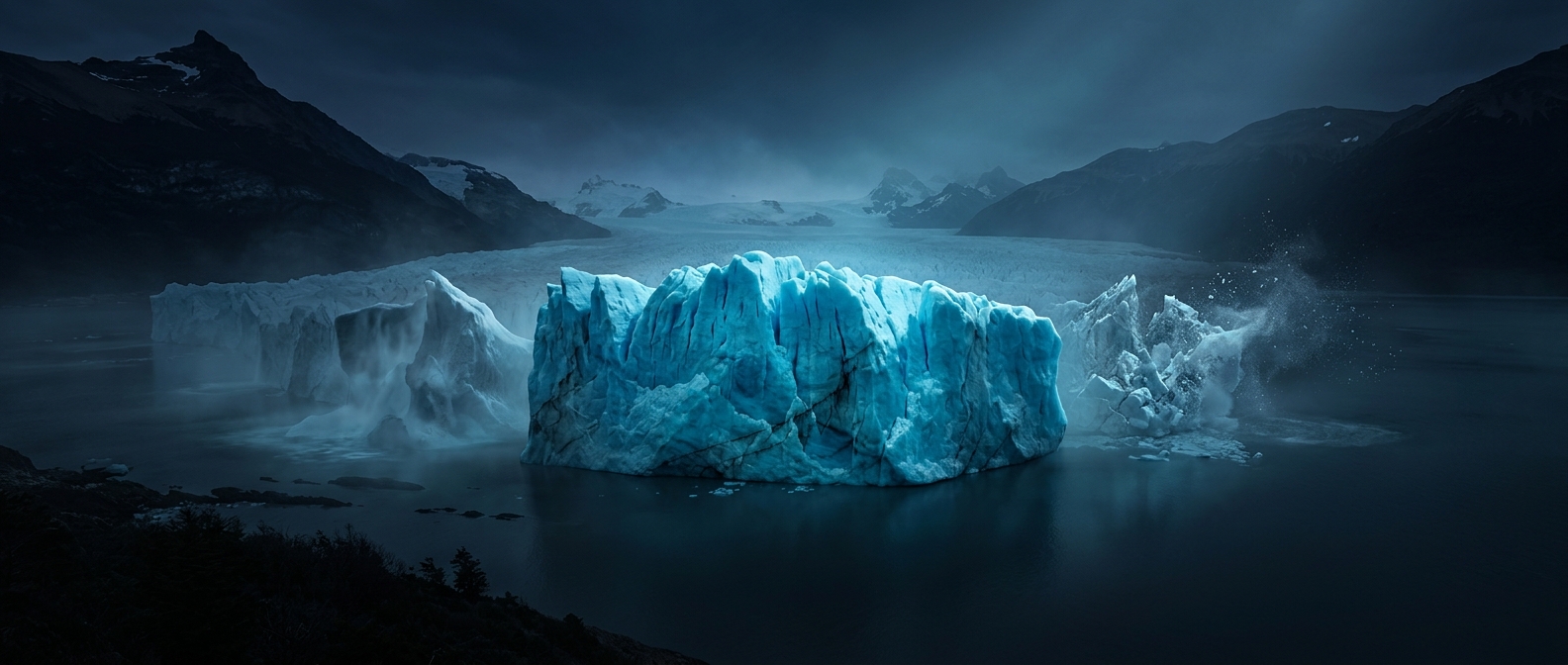
How Perito Moreno’s ice keeps moving forward
In Patagonia’s Los Glaciares National Park, Perito Moreno Glacier flows downhill from the Southern Patagonian Ice Field toward Lago Argentino. The ice is not a frozen slab: snow accumulating high on the ice field is compressed into ice, which slowly deforms and slides under gravity. At the glacier’s front, ice breaks away or melts. Its position reflects the balance between that forward supply and the losses at the edge.
At Perito Moreno, the supply has at times been strong enough for the snout—the glacier’s front—to push into the lake and across a narrow channel. That makes the glacier’s behavior unusually visible: its advance can alter the shape and flow of the water it meets.
A temporary ice dam, then a rupture
When the glacier blocks the channel, it separates part of Lago Argentino, creating a difference in water level on either side. Water pressure builds against the ice barrier and can force water through cracks. As the cracks widen, the barrier becomes unstable and eventually breaks apart in a dramatic collapse. The rupture releases the trapped water and reconnects the lake’s sections.
This is a natural cycle, not a permanent dam. The glacier continues to flow, the channel can close again, and the sequence may repeat—though the timing is irregular. From the shore, visitors can see the enormous scale of the ice; the less obvious story is that the glacier’s motion is also reshaping the lake, one advance and rupture at a time.