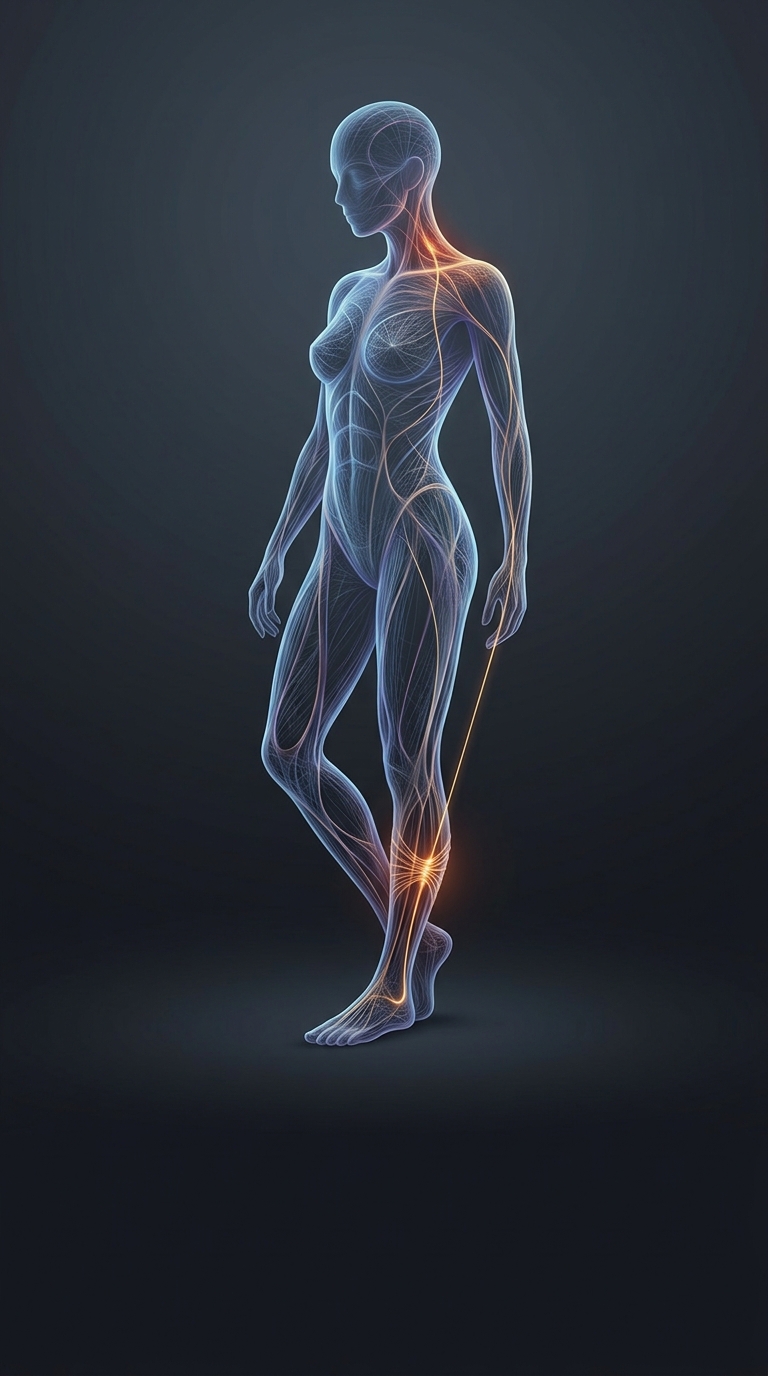
How connective tissue links distant parts of the body
Fascia is a network of connective tissues that surrounds and separates muscles and other structures, and blends with tendons and ligaments. It is not one smooth sheet wrapped tightly around every part. Some fascia forms broad layers; other portions make thinner partitions or sleeves. Together, these tissues help support organs and give muscles a framework in which to move.
How tension can travel
Fascia contains collagen fibers, which resist pulling. When a muscle contracts or a joint moves, force can pass through its attachments into nearby connective tissues. Because those tissues continue into neighboring layers, a change in tension can affect regions beyond the one producing the movement. A restriction or altered movement in one area may therefore contribute to strain elsewhere—for example, through the way a person shifts weight while walking.
The layers also need to glide over one another. Their structure and the fluid between them help make that movement possible. If tissues become less mobile, nearby movement may feel restricted or uncomfortable. But the body is not a taut web in which every tug produces a predictable sensation at the far end. The direction and effect of force depend on posture, movement, tissue properties, and the many other structures involved.
A connection is not a pain map
Fascia has sensory nerve endings, so it can contribute to pain and other sensations. Yet pain is shaped by more than tissue tension: nerves, joints, muscles, and the nervous system’s interpretation of signals all matter. A sore foot might influence how someone walks and add load elsewhere, but that does not prove the foot caused pain in another location—or that every distant ache can be traced back to it.
The useful takeaway is that body regions can influence one another through movement and shared connective tissues. That is a reason to consider the whole movement pattern, not a shortcut for diagnosing pain from a single point.