Why Uranus’s Rings Can Seem to Disappear
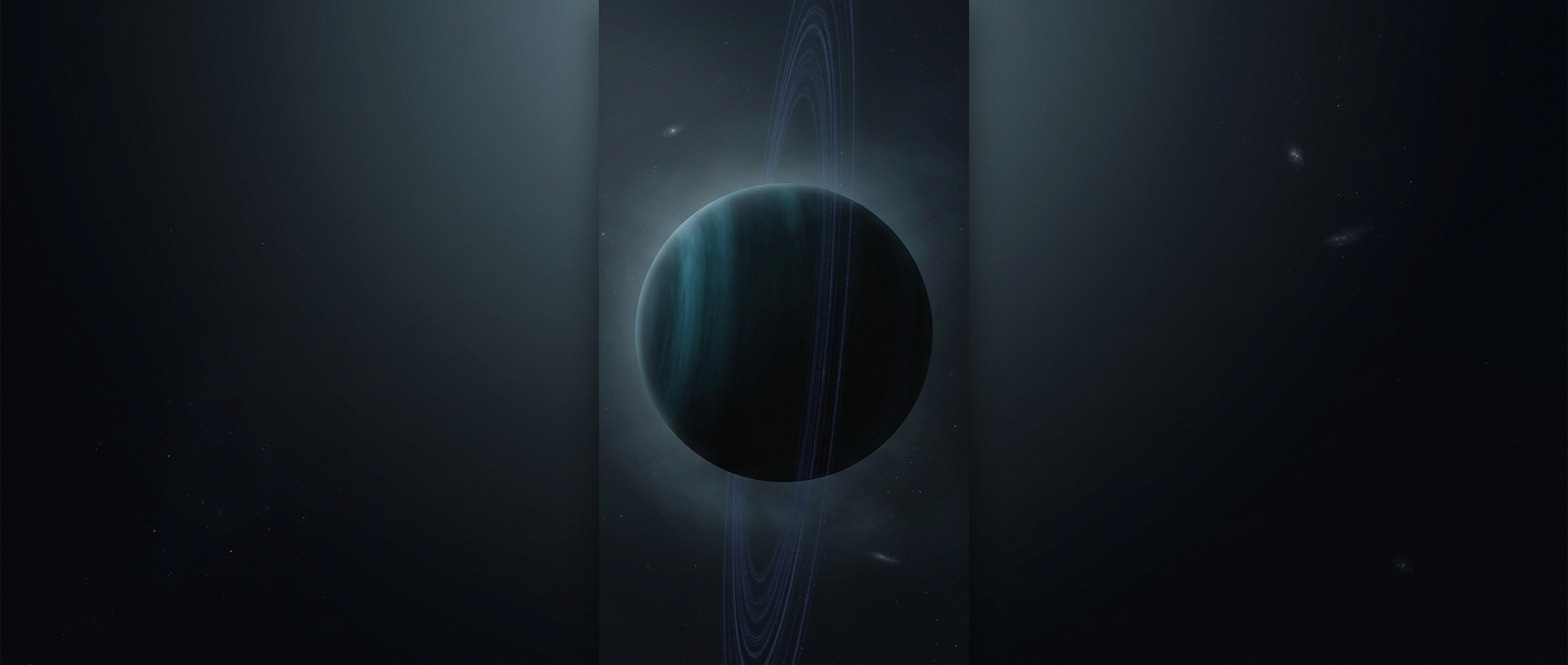
A ring system is easiest to see when its broad, flat face is tilted toward us. Uranus’s rings are narrow and lie in a plane around the planet’s equator. When Earth’s view lines up nearly with that plane, we see the rings edge-on: their width is compressed into a thin line, so the dark, faint material can become extremely difficult to distinguish from the planet’s glare.
The rings have not folded up or gone away. We are simply looking across their thickness rather than across their broad surface—like viewing a sheet of paper edge-first.
A Changing View, Not a Changing Ring System
Uranus orbits the Sun with its axis tipped dramatically on its side. As the planet moves along its orbit, the direction from Earth to Uranus changes relative to the planet’s rings. At certain points, Earth’s line of sight crosses the ring plane, creating an edge-on view. Later, the rings appear to open out again as we see them at a less flattened angle.
This alignment is called a ring-plane crossing. It is a perspective effect, but it also gives astronomers a useful view: with the bright face of the rings turned away, observations can reveal details that are otherwise harder to separate from reflected light.
What the “Disappearing Act” Reveals
The apparent vanishing makes the rings’ geometry visible. Their changing appearance tracks the angle at which we see Uranus, not a sudden change in the rings themselves. A nearly invisible line can therefore be evidence that Earth, Uranus, and the ring plane have briefly lined up—an astronomical event created by where we happen to be looking from.