A living network grows toward food
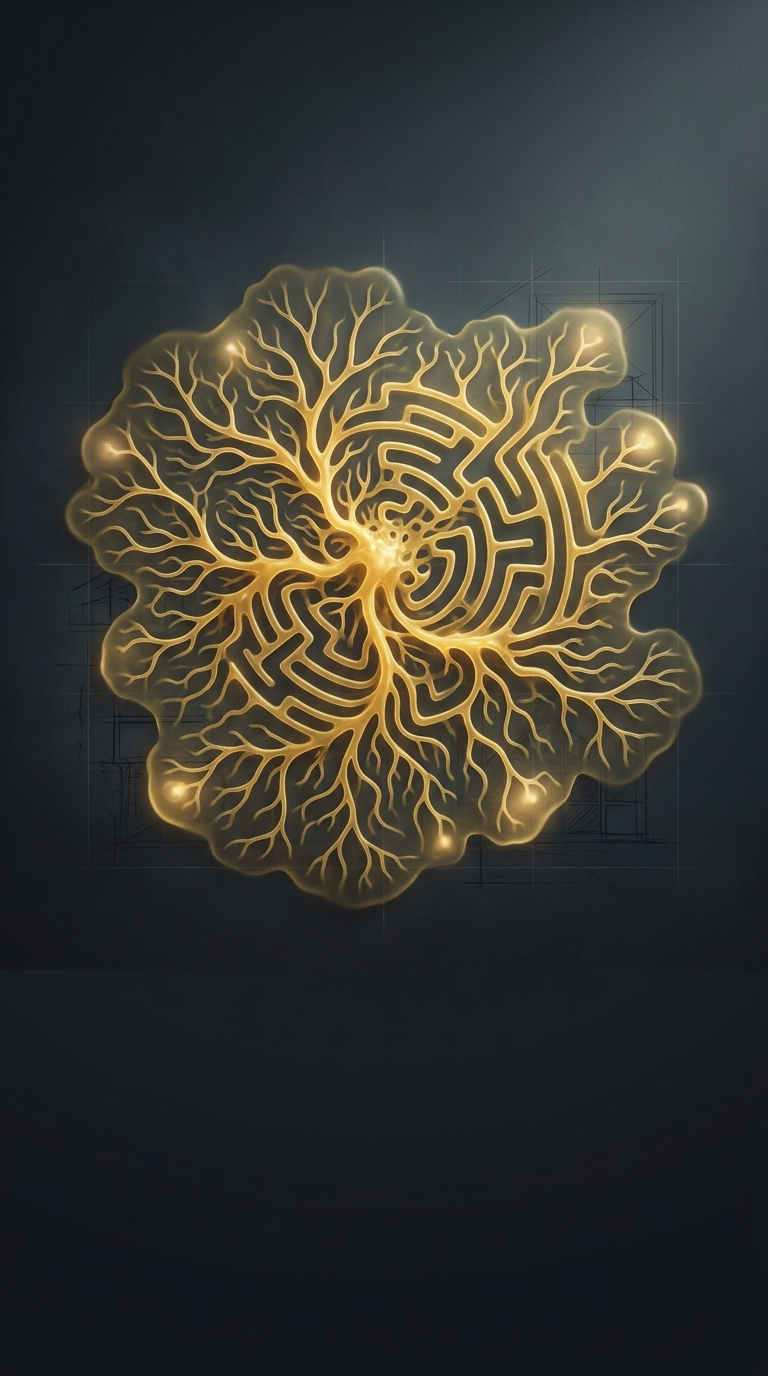
A slime mold such as Physarum polycephalum may look like a blob, but its feeding body is one large cell containing many nuclei. As it spreads, it forms branching tubes that carry nutrients through the cell. Food releases chemical cues that encourage growth nearby, while unproductive branches can shrink.
That simple growth-and-pruning process can produce a useful route system. The mold does not recognize stations or plan a map. Instead, researchers place food at selected points, and the organism’s changing tubes link the rewards it can reach.
How the tubes edit the route
Material flows back and forth through the tubes, helping transport nutrients around the network. Connections that carry more flow tend to be reinforced; weaker ones may dwindle. Over time, the mold shifts resources toward links that serve food sources efficiently.
In the Tokyo comparison, researchers positioned food to represent stations in the area’s rail network. The mold’s final pattern resembled important rail connections: it linked the food sites while trimming less useful growth. The match was striking because the organism had no map or central controller—its network emerged from many local changes.
Efficiency is not the only test
A short route is not necessarily a dependable one. If every pair of food sites is connected by a single thin tube, losing that tube could split the network. A network with extra links may use more material, but those links can provide alternate paths.
The mold’s growth therefore illustrates a practical design tradeoff: a useful network must balance economical connections with resilience when a route fails. Researchers can study that balance by comparing the organism’s networks with engineered systems. The slime mold is not solving transit planning in the human sense; it is physically testing which connections persist as food access and flow change. A rail map can be drawn at a desk. The mold’s version is built, revised, and pruned by the movement of living material.