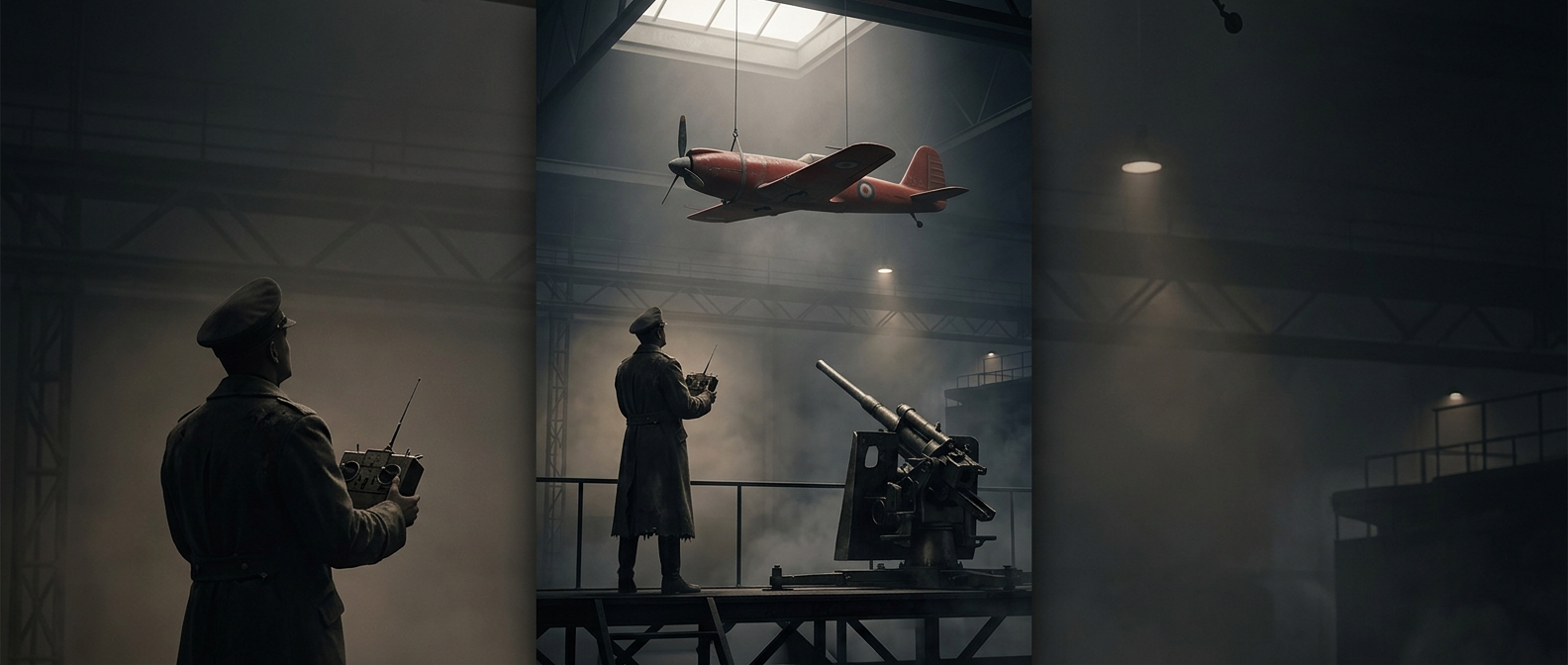
Why armies needed a pilotless target
A stationary target can teach a gunner to aim, but it cannot reproduce the problem of shooting at an aircraft: the target keeps moving while the gunner must judge where it will be by the time a projectile reaches it. In the 1930s, radio-controlled planes offered a way to practice against a target in flight without putting a pilot aboard.
An operator on the ground sent radio commands to mechanisms in the aircraft, steering it through the air. That made it possible to guide a plane across a firing range while crews practiced tracking and aiming. The aircraft itself could be expendable; the person controlling it did not have to be in the line of fire.
A training tool that pointed toward drones
These early target aircraft were not autonomous in the modern sense. They depended on a human operator and radio control, rather than onboard computers deciding where to fly. Their value lay in separating two jobs that had previously been linked: a plane could act as a moving aircraft-shaped target, while its pilot stayed safely on the ground.
That arrangement also exposed the basic tradeoff of target practice by aircraft. A target that moves realistically is more useful, but it is harder to recover if it is hit or loses control. Even so, radio-controlled targets established a lasting role for unmanned aircraft: they could take risks in the air that would be unacceptable for a crewed plane. The earliest drones were built not to observe or attack, but to give gunners something real to aim at.