A Closed Loop for Slow Distillation
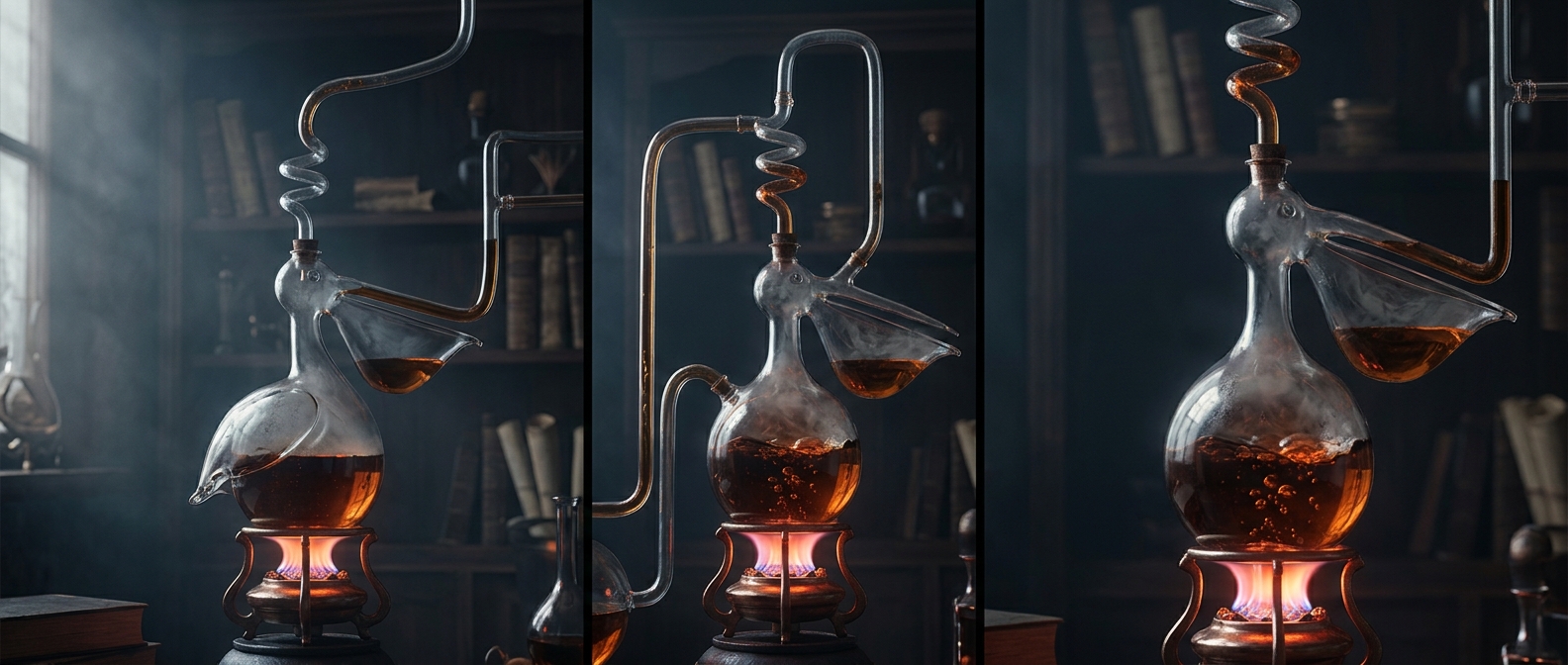
A pelican vessel turns distillation into a cycle rather than a one-way separation. Heat makes some of a mixture evaporate; the vapor rises through the glass, cools, and becomes liquid again. In an ordinary distillation, that condensed liquid is collected elsewhere. In a pelican, the return paths carry it back into the heated flask.
The returning liquid can then be heated and evaporated again. Repeated circulation keeps volatile parts of the mixture moving through the same process, while less volatile material tends to remain behind. The vessel does not create a new substance by itself: what it can separate or concentrate depends on the starting mixture, the temperature, and how long the cycle runs.
Why Alchemists Valued the Shape
The apparatus made a slow, unattended operation possible without repeatedly pouring the distillate back by hand. Its closed form also suited the alchemical idea of circulation: a material could be refined by passing through a recurring sequence of rising, cooling, and returning. Alchemists used such processes in attempts to obtain concentrated essences from substances, though the spiritual or transformative meanings they attached to an “essence” went beyond what the apparatus alone could establish.
The name comes from the vessel’s silhouette: its paired curved tubes were likened to a pelican bending its beak toward its body. The striking design is also practical. It lets the same liquid revisit the heated chamber again and again, turning a simple glass flask into a compact loop for repeated treatment.