Why a Ship Can Ride Up Without Adding Its Full Weight
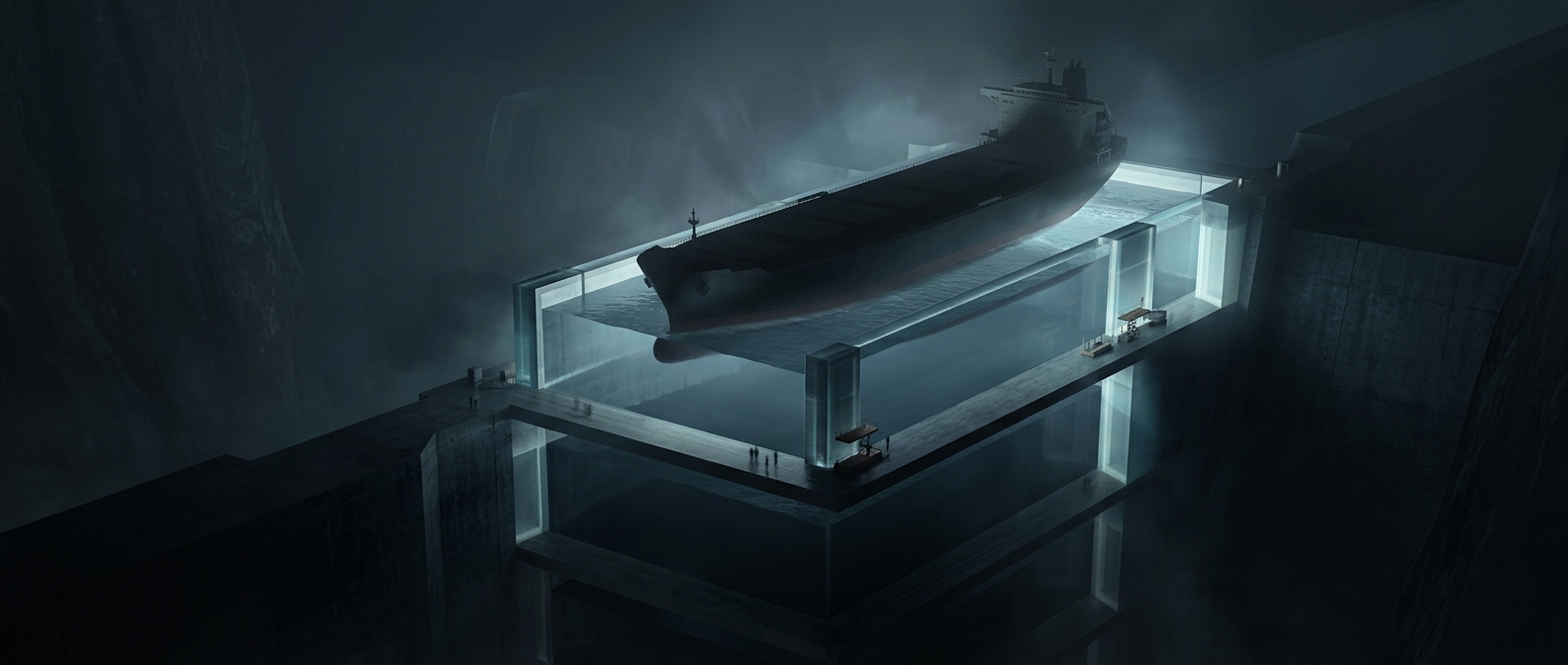
A water-filled caisson is a large, watertight chamber that carries a boat between two different water levels. The surprising part is that loading the boat need not make the chamber substantially heavier: a floating ship pushes aside water equal in weight to the ship. As it enters, it displaces that much water from the caisson. The ship’s weight replaces the weight of the water that flowed out.
That principle is buoyancy—the upward support a fluid provides to an object. It lets the lift move a boat without asking its motors to raise the boat’s entire mass on top of the water already in the chamber.
Moving Two Caissons as a Balanced Pair
Many water-box lifts use two caissons connected so that one rises as the other descends. Their loads largely balance: the motors mainly overcome friction and make up for small differences, rather than hauling two enormous chambers independently. The boat’s arrival therefore changes the balance far less than its size might suggest.
At each end of the lift, gates connect a caisson to the channel. They must close before the chamber moves and open only when it reaches the matching water level; otherwise, water would escape and disrupt the lift. The caisson is effectively a short stretch of canal that can travel vertically.
The design’s practical payoff is that boats can cross a steep change in elevation without a long sequence of locks. Instead of repeatedly filling and draining lock chambers, the lift carries a water-filled section of the route—and the ship floats through it.