Why a Wide Boat Can Move Quickly
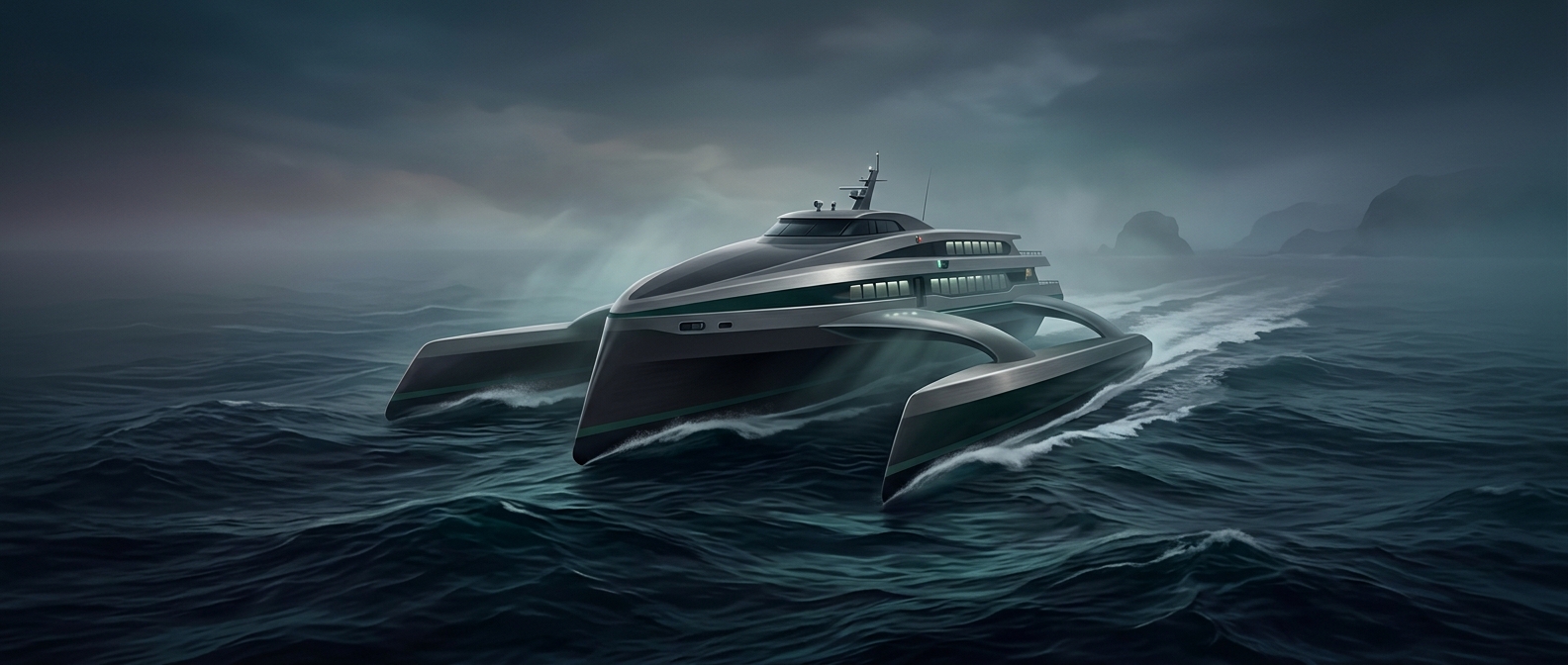
A fast ferry has to solve two problems at once: push through water efficiently and remain steady enough for passengers and machinery. A trimaran separates those jobs. Its long, narrow center hull carries much of the load, while the two smaller side hulls—called outriggers—sit far apart and help resist rolling.
That spacing matters because a boat resists tipping more strongly when buoyancy acts well away from its centerline. The main hull can therefore stay relatively slim instead of being made broad simply to gain stability. A slimmer hull generally pushes less water aside as it moves, which can reduce resistance at speed.
The Tradeoff Is in the Waves
The outriggers are not just passive supports. Their size, position, and shape affect how the ferry behaves as waves pass beneath it. Designers must balance stability against impacts and loads: in rough water, waves can strike the underside of the broad deck spanning the hulls, and the side hulls can meet waves differently from the center hull.
This makes the space between hulls part of the design problem. A trimaran’s proportions have to suit its operating conditions, speed, and payload; simply spreading the outriggers farther apart is not an unlimited improvement. More separation can strengthen resistance to rolling, but it also changes the forces the connecting structure must carry.
What Passengers Gain
For a ferry, the point is not speed alone. A stable platform can make fast crossings more practical, while the narrow central hull helps avoid the drag of a much broader single hull. The result is a vessel whose distinctive width comes from its stabilizing arrangement—not from making the main hull blunt.