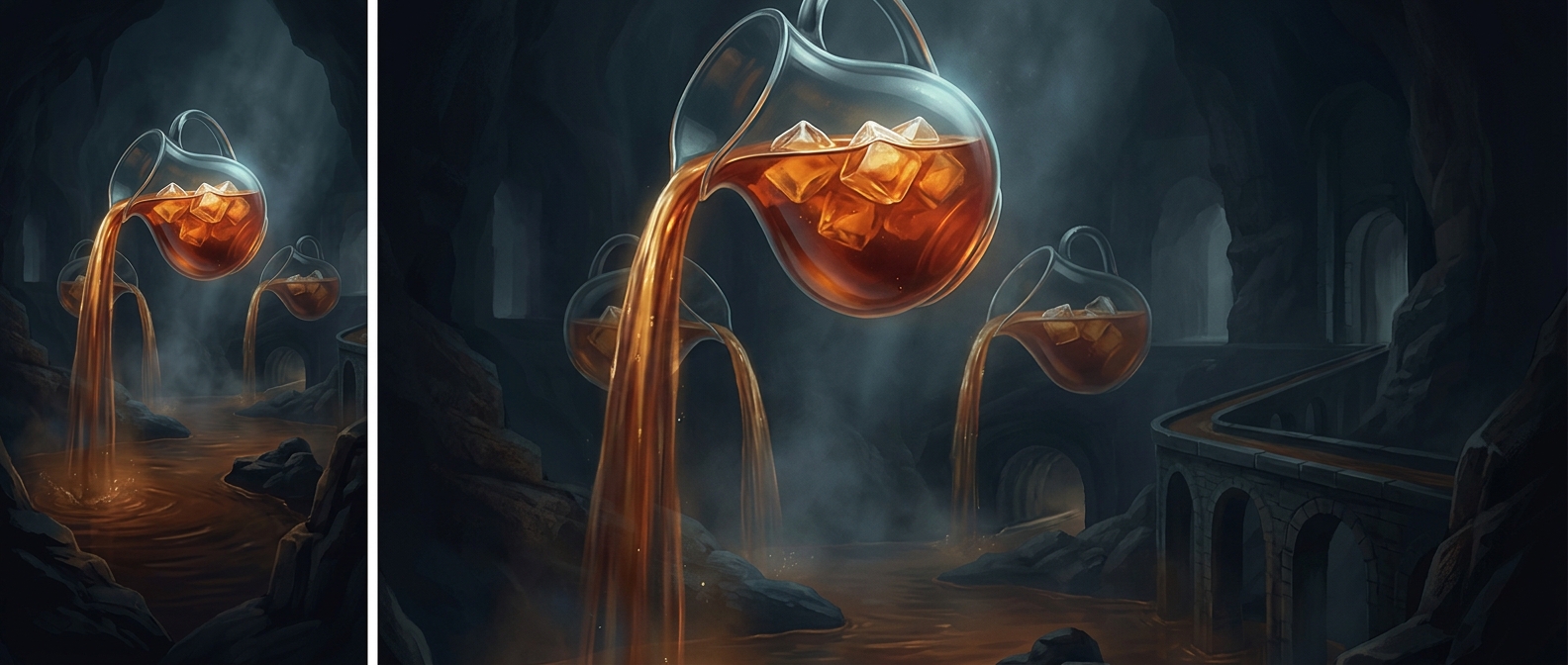
Why a Pitcher Pours Smoothly
A pitcher has to solve a small traffic problem: liquid needs to leave through its spout, but the space it leaves behind must be filled. If air cannot enter easily, the pressure inside drops as tea pours out. The lower pressure pushes back against the tea, slowing the flow until air breaks in with a bubble. That alternating rush can make the familiar gulping, or “glugging,” sound.
The Handle Helps Control the Exchange
A pitcher’s handle does more than make a full container easier to lift. It gives the hand leverage to rotate the pitcher gradually, so the spout can be lowered while the opening remains positioned to admit air. As tea exits, air can travel back into the pitcher rather than having to fight its way through the same narrow path in uneven bursts.
The spout also shapes the stream. Its lip guides liquid away from the rim, while the pitcher’s tilt determines how much tea flows at once. Together, a controlled angle and a route for incoming air keep the outflow more continuous.
A Simple Balance in Motion
This is the same basic exchange that governs many pouring containers: one material moves out, another must move in to occupy the space. A narrow-necked bottle may glug because liquid and air compete for limited room; a pitcher’s broad opening and easy-to-adjust angle make that exchange less abrupt. The smooth pour is not just a matter of a polished stream—it is a sign that tea leaving and air entering are staying in balance.