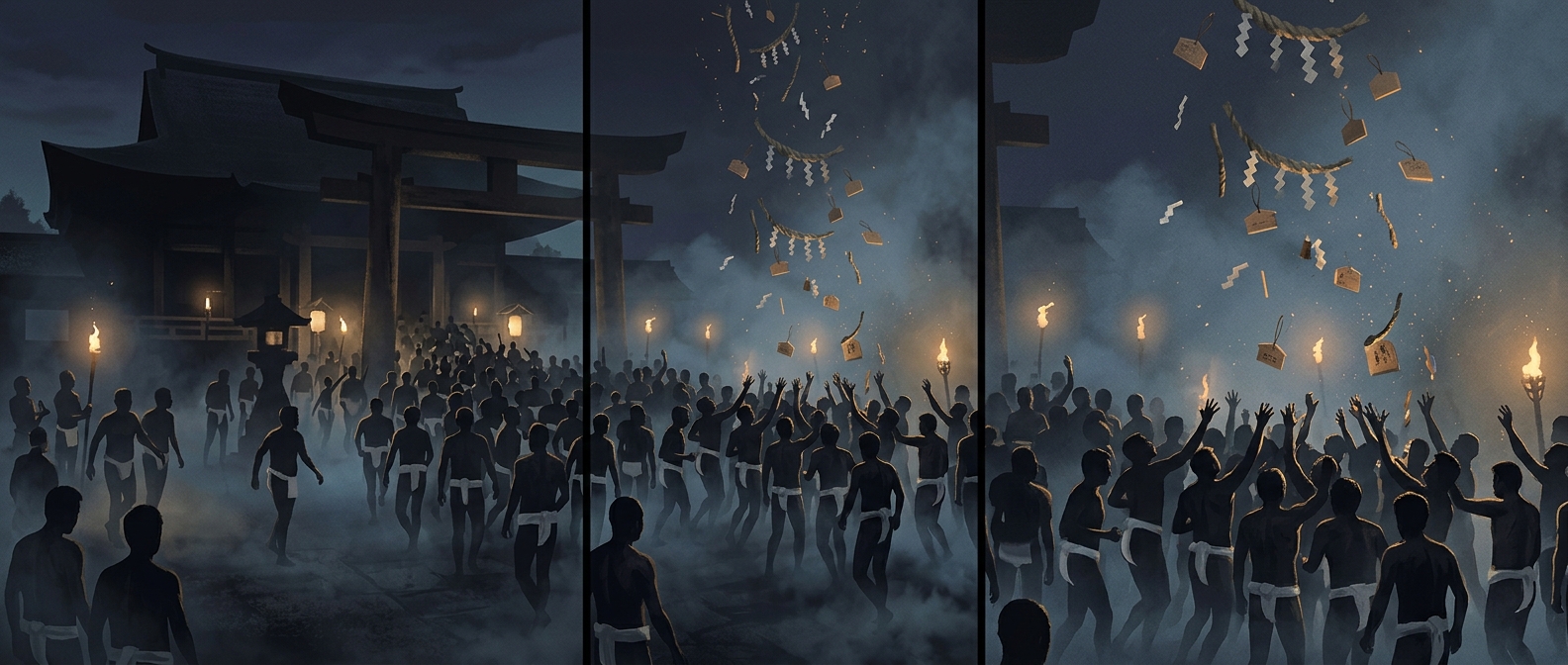
The scramble for Saidaiji’s lucky sticks
In Okayama, the Saidaiji Eyo Festival turns a small wooden prize into the focus of a very large contest. Priests throw sacred sticks, called shingi, into a packed crowd of men reaching to catch them. The prize is believed to bring good fortune to whoever secures it.
The contest is not simply about grabbing a stick and holding on. A participant must get a shingi into a wooden box called a masu to be recognized as the year’s lucky man. That requirement gives the crush a clear goal: the sticks matter because of what completing the ritual represents, not because the wood is valuable on its own.
Why the crowd presses in
The sticks are released into the darkness from the temple, so participants cannot easily see where they will land. Hundreds of bodies shifting toward a prize in that uncertainty make the competition intensely physical. The crowd’s movement is part of the spectacle—and the reason the festival is famous—rather than a backdrop to a ceremony performed at a distance.
The struggle also makes luck tangible. A belief that good fortune can be attached to a sacred object becomes a contest with an unmistakable outcome: one person manages to catch a stick and place it in the box. For spectators, the drama lies in watching that attempt emerge from the crush. For participants, the prize offers a memorable way to begin the year with a claim to fortune.