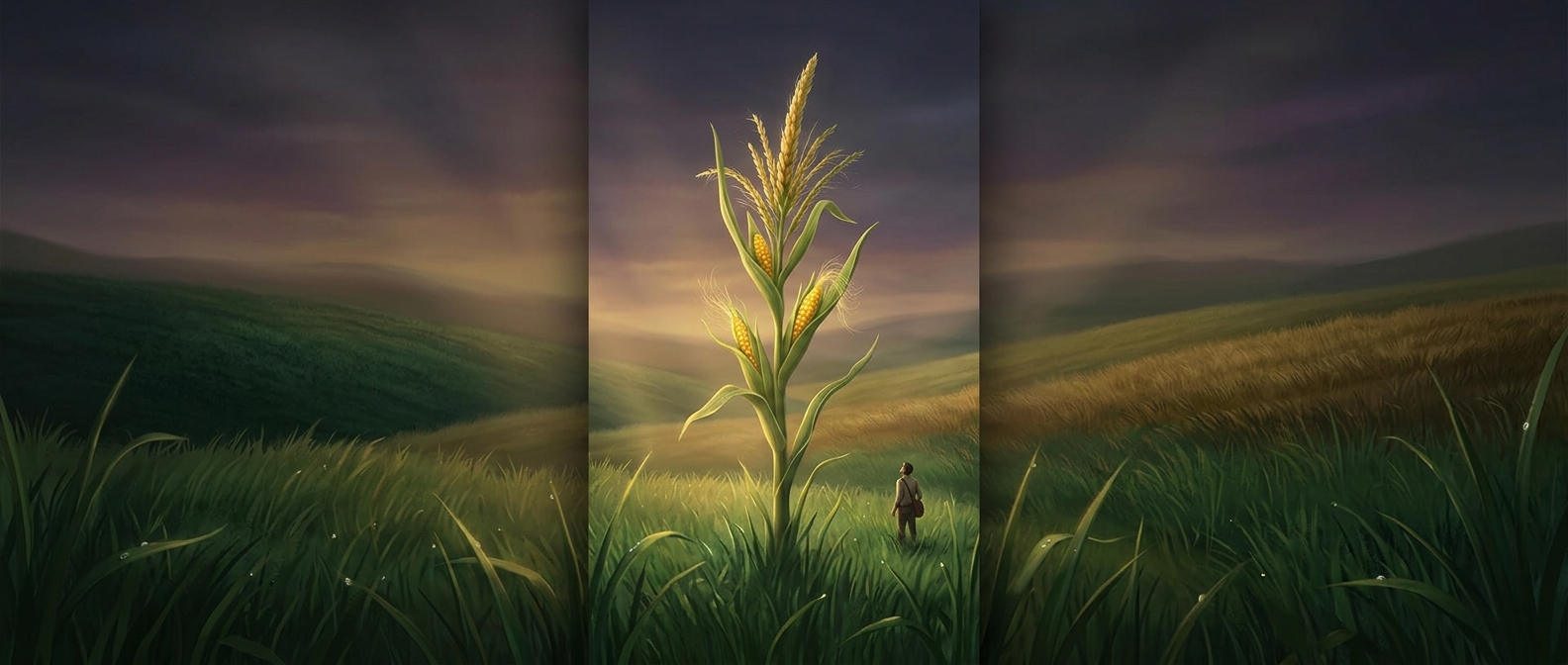
How a grass makes a corn kernel
Corn’s family resemblance to lawn grass becomes clearer when you look at how its flowers are arranged. The tassel at the top of a corn plant releases pollen; the threadlike silks on an ear lead to tiny female flowers. Each silk connects to one flower, and successful pollination allows that flower’s ovary—the structure that can develop into a fruit—to grow into a kernel.
That process explains why an ear has so many silks: each potential kernel has its own route for pollen to reach it. If a silk is not pollinated, the flower may not develop a full kernel, leaving a gap in the row.
The kernel’s built-in package
In most fruits, the fruit wall and seed are visibly separate: think of a peach surrounding a pit. In corn and other grasses, the fruit wall, called the pericarp, becomes tightly fused to the seed coat. The result is a dry, one-seeded fruit known as a grain, or caryopsis.
This arrangement is practical for a plant whose seeds mature exposed in a compact head. The fused layers protect the seed while keeping the grain small and easy to disperse or harvest. When you eat corn, you are eating that whole package—not separating a fruit from its seed. The same basic structure is found in wheat and rice, which is why “grain” names a familiar food category even though, botanically, each grain is a fruit.