How a Dartboard’s Wires Turn a Hit Into a Deflection
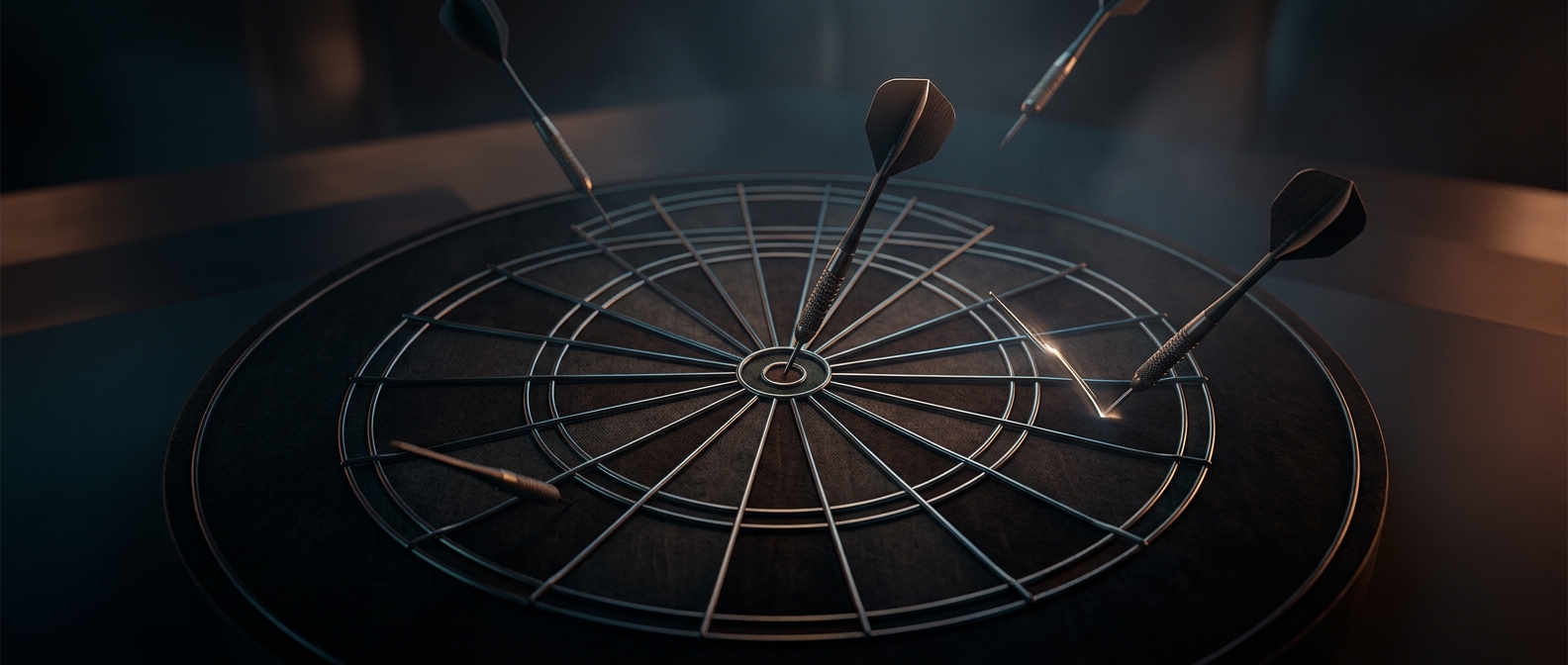
The thin wires separating a dartboard’s scoring sections do more than mark boundaries: they are obstacles a dart can strike instead of the board’s fiber surface. If the dart hits a flat, blunt divider head-on, its tip may stop short of embedding. The dart’s remaining motion can then send it bouncing back onto the floor—a “bounce-out.”
Many boards use angled or blade-shaped dividers. Their sloped faces give a glancing dart a surface to slide along, guiding its tip toward the board rather than presenting a broad, flat barrier. In effect, some of the dart’s forward motion is redirected into the board face, where the tip can catch in the tightly packed fibers.
Why the Shape Matters
A divider has to be sturdy enough to keep neighboring scoring sections distinct, but every bit of wire also occupies space where a dart cannot stick. Angling the wire helps reduce the chance that an off-center hit will strike a broad obstruction. It cannot prevent every bounce-out: a dart that hits a divider squarely, or arrives at an awkward angle, may still fail to lodge.
The design’s practical payoff is that more near-boundary throws can stay on the board and count, while the wires continue to separate the scoring areas. A small change in the divider’s profile can therefore affect both how often darts stay put and how much usable target area players get.