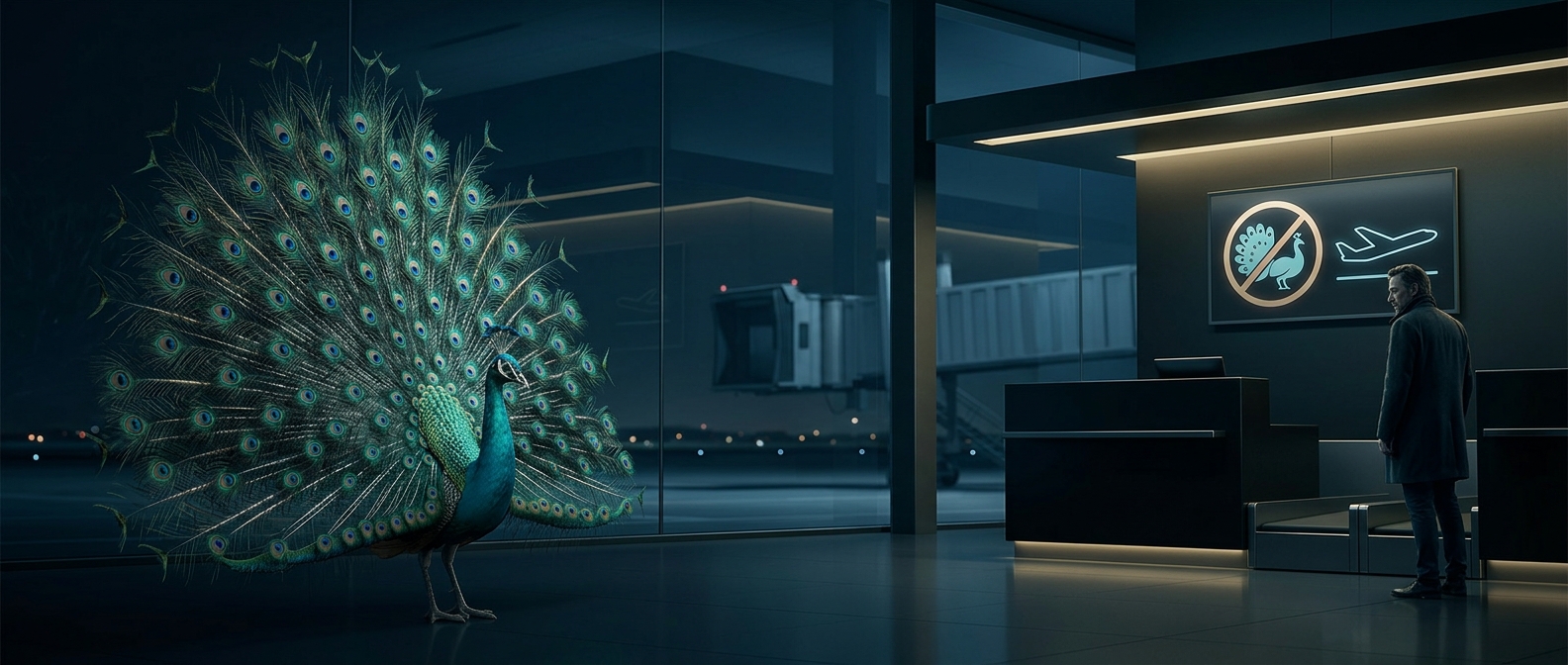
Why a Peacock Couldn’t Claim a Seat as an Emotional Support Animal
The key distinction is what the animal is trained to do. A service animal is trained to perform a specific task for a person with a disability, such as guiding someone who is blind. An emotional support animal may provide comfort, but it is not necessarily trained to carry out a task. For years, airlines faced pressure to accommodate a wide range of animals under the emotional-support label, even when they were not accustomed to crowded, noisy cabins.
A Cabin Is a Confined, Shared Space
An airline must manage animals around other passengers, crew, and emergency procedures. A large bird or pig can take up space, move unpredictably, or create sanitation and allergy concerns. And when an animal is presented as necessary for emotional support, staff may have little basis for judging how it will behave during boarding, turbulence, or an evacuation.
That made the rules difficult to apply consistently: one passenger might bring a small, familiar pet, while another sought to bring an unusual species that could not fit ordinary cabin arrangements. The peacock became a vivid example of how broad the category could become.
The Rule Changed the Accommodation, Not Every Pet Policy
U.S. regulators narrowed the animals airlines must recognize as service animals to trained dogs. That means passengers cannot require an airline to treat a peacock, pig, or other non-dog as a service animal simply because it provides emotional comfort. It does not mean every animal is categorically forbidden from flying: airlines can still allow pets under their own rules, which may limit species, size, carriers, and routes.
The practical consequence is that an animal’s place in the cabin depends less on a claimed emotional role and more on whether it meets the airline’s service-animal standard or its separate pet policy.