The muscles that move your fingers sit upstream
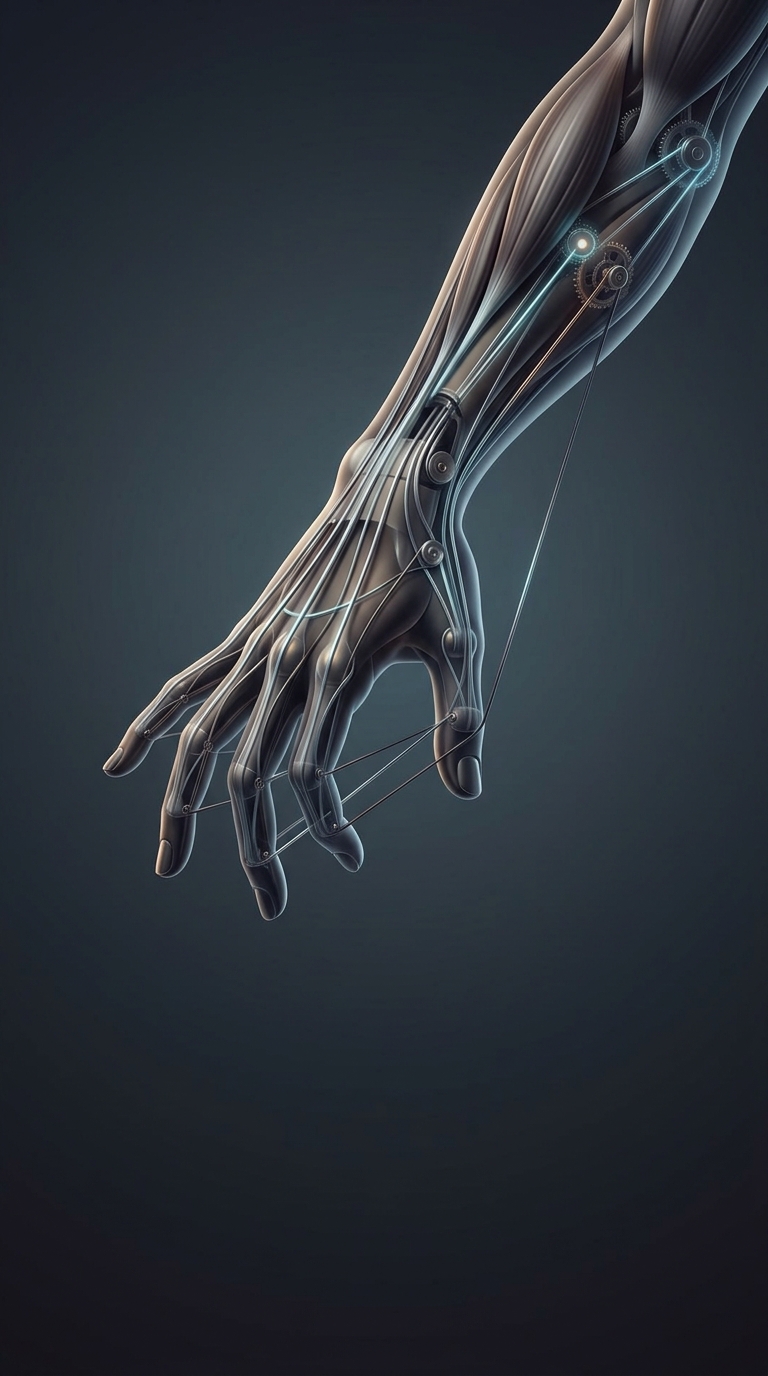
A finger bends when a muscle tightens and pulls on a tendon—a tough, cordlike band that connects muscle to bone. The tendons run into the fingers, where they attach to the bones and transmit that pull. The fingers themselves contain no muscle tissue, so their fine movements depend on motors located elsewhere in the hand and arm.
Many of the strongest finger-bending muscles are in the forearm. Their tendons pass through the wrist and palm before reaching the fingers. Other small muscles are located within the palm; these help spread the fingers, bring them together, and coordinate precise movements. Together, these two groups give the hand both strength and control.
A guided path keeps tendons in place
Finger tendons do not simply whip across the hand like loose cables. In the fingers, they pass beneath narrow bands of tissue called pulleys, which hold them close to the bones as the fingers bend. A lubricated covering around many tendons helps them glide with less friction. This arrangement lets a tendon change direction and pull efficiently without bowing away from the finger.
Different tendons also handle different jobs. One set bends the fingers; another straightens them. The brain and nerves coordinate these pulls, adjusting how much each muscle contracts so a hand can grip a cup, tap a screen, or control a musical instrument.
Precision comes from coordination, not fingertip muscles
Because the motors are distributed through the palm and forearm, a fingertip’s apparent independence is partly an illusion: its movement depends on a coordinated system of muscles, tendons, joints, and nerves. A small adjustment in muscle tension can change a light touch into a firm grip. The fingers do the contacting, but the work begins upstream—and tendons carry the instructions all the way to the bones.