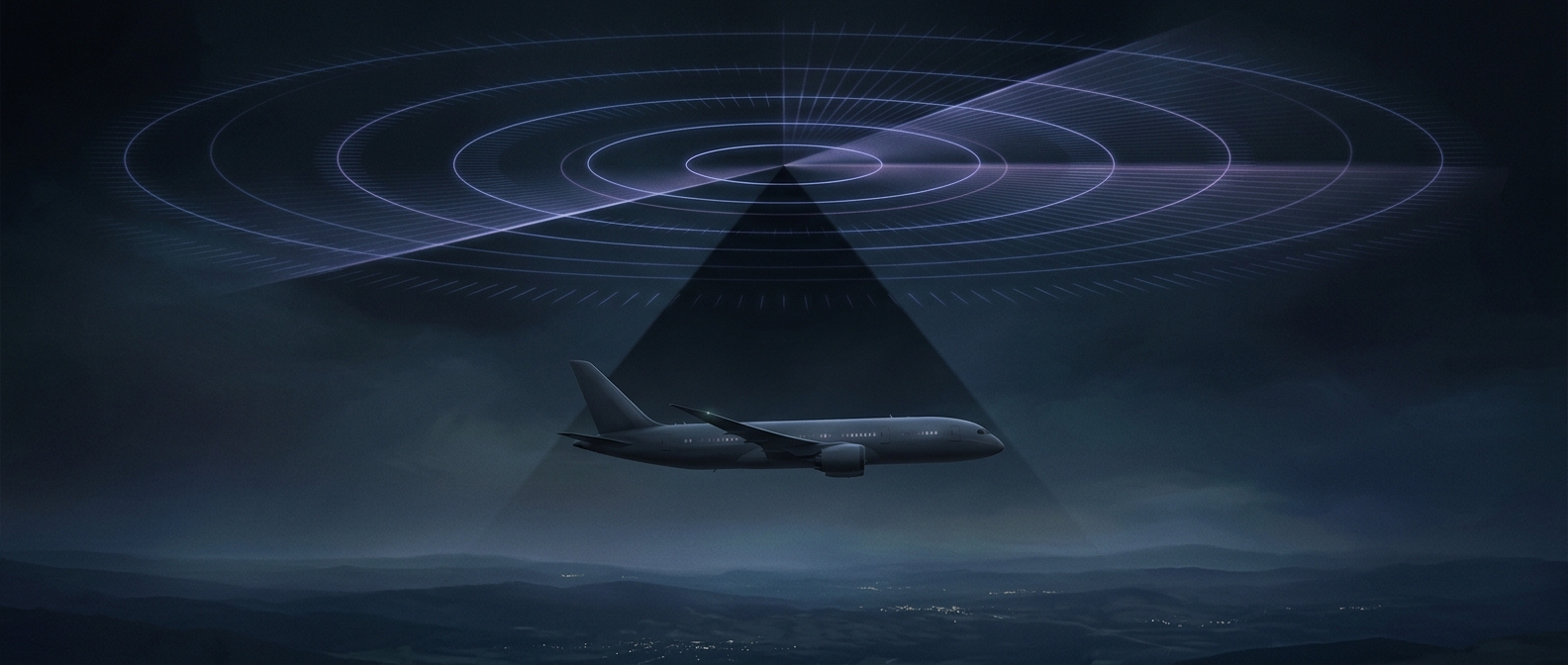
Why an aircraft can pass through a radar’s overhead gap
A conventional rotating air-surveillance radar spends each revolution sweeping its beam around the horizon. The beam has some vertical thickness, but it usually does not point straight up. That leaves a cone-shaped region above the antenna where the beam cannot reliably detect targets.
As a plane approaches the tower, it may appear on the scope while its angle from the horizon is within the beam’s coverage. Near the closest point overhead, that angle becomes too steep: the aircraft passes above the beam and its radar return can drop out. Once it has moved farther away, the angle becomes shallower again, and the radar may detect it once more.
A brief gap, not an invisible aircraft
The plane has not disappeared; only that particular radar’s view has. How long the gap lasts depends on the radar’s antenna pattern and the aircraft’s altitude, speed, and route. Other radars, positioned elsewhere, may see the aircraft during the same passage, and air-traffic systems can combine information from multiple sources.
The geometry is a useful reminder that radar coverage is not a solid dome. Even a powerful tower has angles it cannot see well, which is why dependable tracking relies on overlapping coverage rather than one antenna watching every point in the sky.