Why the shadow speeds up with distance
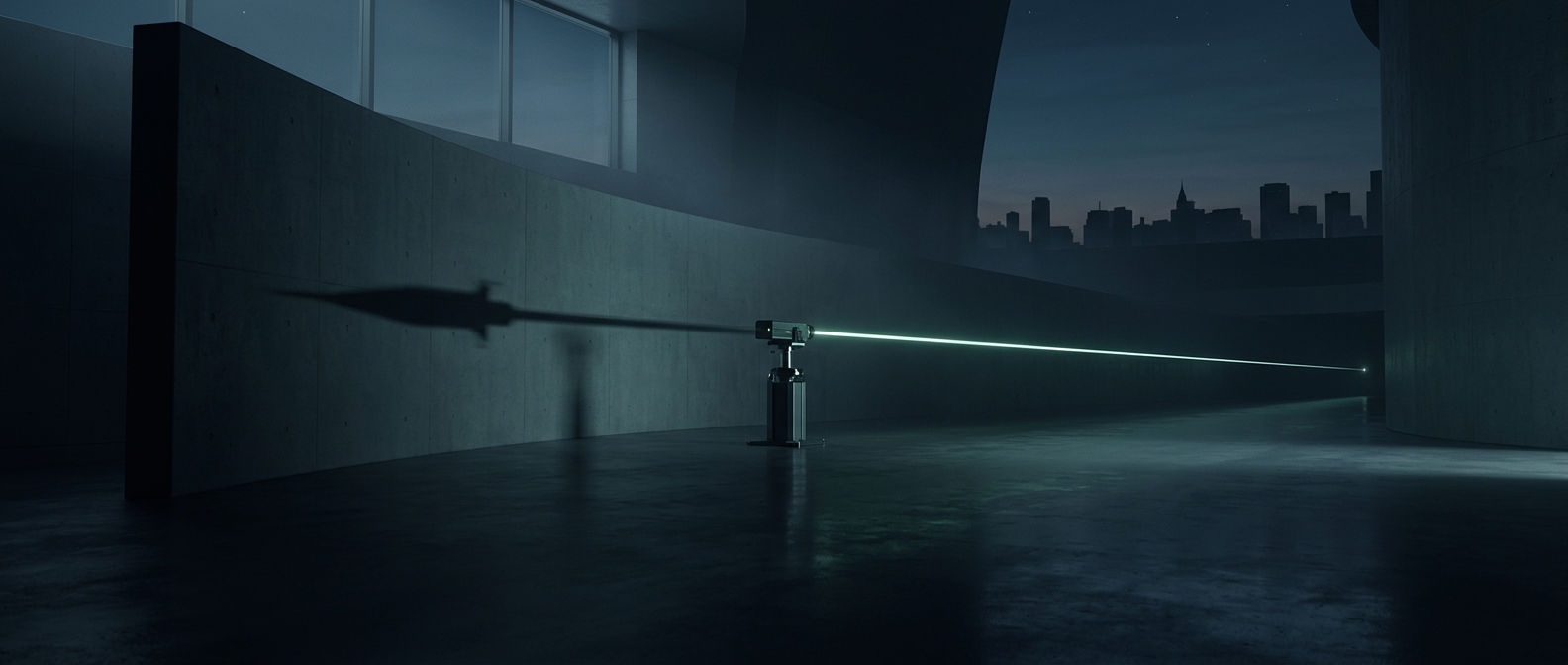
Imagine sweeping a flashlight beam across a distant wall. As you turn the flashlight at a steady rate, the beam’s direction changes by the same small angle in the same amount of time. But farther from the flashlight, that angle spans a larger stretch of wall. The illuminated patch—and the boundary between light and darkness—therefore appears to move faster across the distant surface.
For a flat surface facing the beam, the apparent speed is roughly the surface’s distance from the flashlight multiplied by how quickly the beam’s direction changes. Increase the distance, and the same angular sweep covers more ground per second. In principle, the calculated speed of the boundary can exceed the speed of light.
A moving boundary isn’t a moving object
The shadow’s edge is not a strip of matter sliding across the wall. It is a changing pattern: one spot stops receiving the flashlight’s light while another spot, farther along, begins receiving it. Each spot responds when light traveling from the flashlight reaches it; there is no need for the first spot to pass anything to the next.
That distinction is why the apparent motion can be faster than light without breaking the speed limit. The speed limit applies to objects and to signals that carry information from one place to another—not to a pattern whose separate parts form in separate places.
What would happen if you tried to send a message?
Suppose someone at one end of the wall tried to use the sweeping shadow to signal someone far away. The distant person could not receive a message before light from the flashlight—or another signal—could reach them. The moving boundary may cross the wall at an extraordinary apparent speed, but it cannot make one location cause an effect at the next faster than light can travel.
So the surprising part is real: a shadow can have a faster-than-light apparent speed. What it cannot do is carry a faster-than-light message.