A sheltered bay gives the glow a place to build
Mosquito Bay lies on Vieques, an island off Puerto Rico, and its narrow connection to the open sea matters. Water still moves between the bay and the ocean, but the exchange is limited. That helps keep its population of bioluminescent dinoflagellates—tiny, light-producing marine organisms—from being dispersed as quickly as it might be in a more exposed setting. The bay’s shape helps concentrate these living lights in one place.
The glow is not a permanent blue color in the water. It comes from flashes produced by the organisms, so the bay can look dark until something disturbs it.
A paddle supplies the trigger
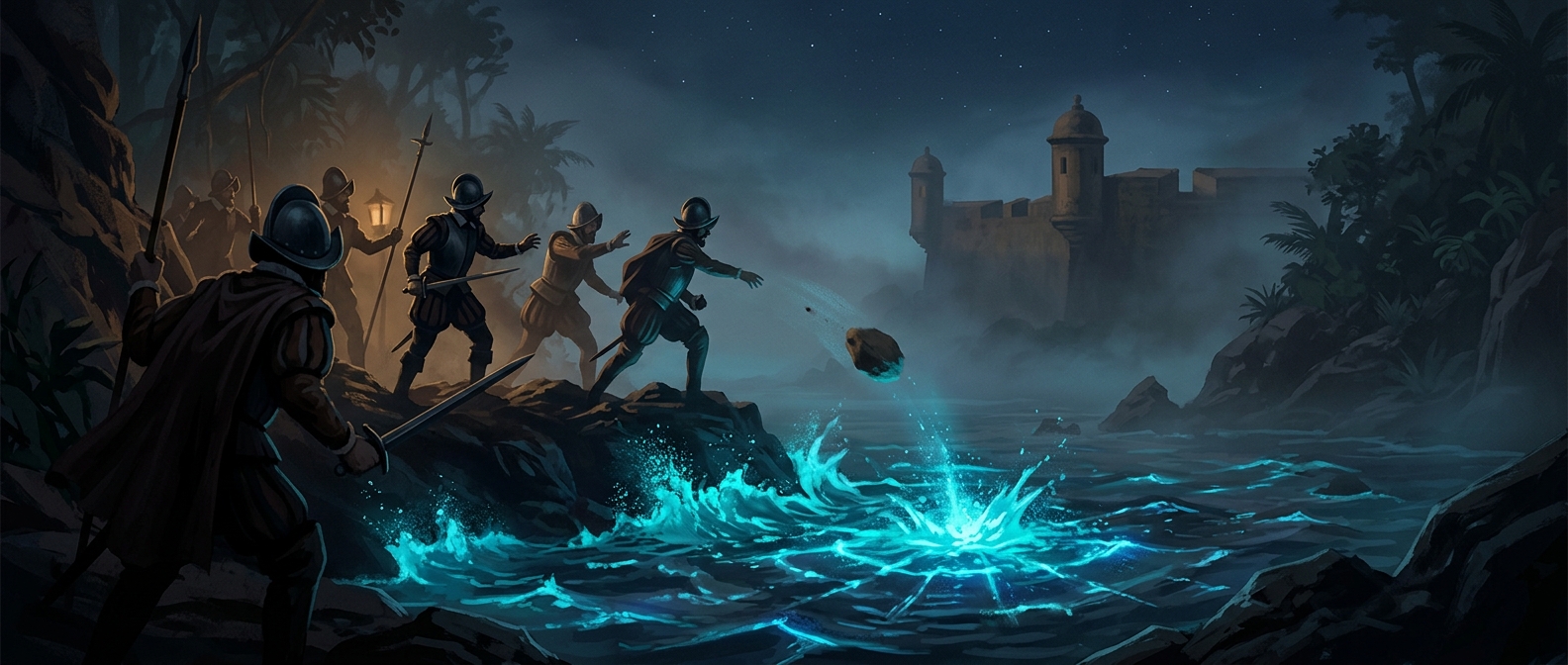
When a paddle cuts through the water, it creates movement around the dinoflagellates. That mechanical disturbance triggers brief flashes of light. A stroke can therefore mark the water with a luminous trail, while a splash can make scattered points of light appear around it.
The distinction is simple but striking: the bay’s sheltered shape helps sustain a dense population, while the visitor’s movement makes that population visible. The light is a response, not a steady glow switched on by the moon or by the paddle itself.
Why the setting changes the experience
In a wide-open stretch of water, currents can carry organisms away and dilute their concentration. Mosquito Bay’s restricted exchange helps maintain the conditions for a dense gathering, so even a small disturbance can produce a conspicuous display. The same inlet that limits the bay’s contact with the sea helps turn an ordinary paddle stroke into a visible trace of living activity.