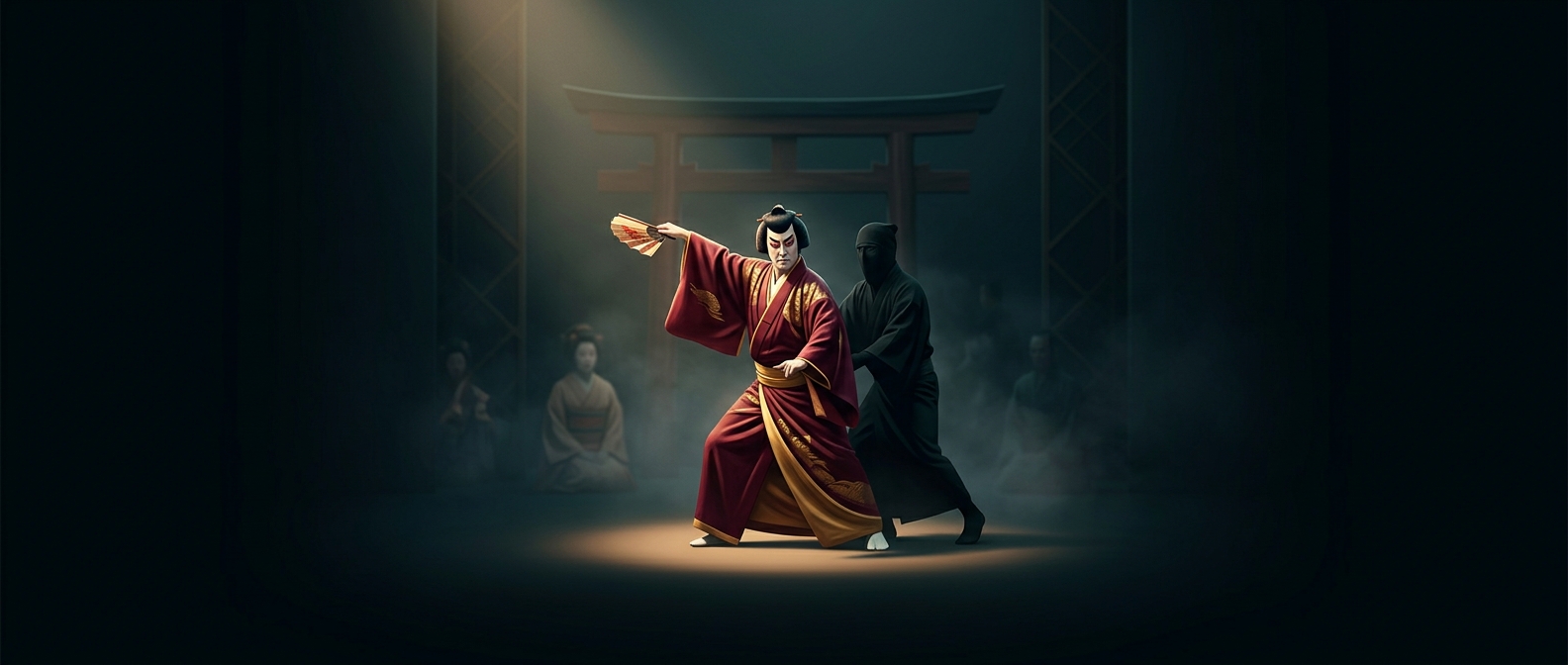
The stagehands are visible—but not part of the story
Kabuki’s black-clad stagehands are known as kuroko. They shift props and scenery in plain view, sometimes helping an actor with a costume or handing over an object. Their clothing signals that they are working backstage even though they are physically onstage: spectators are conventionally asked to look past them, as they would a scene change in the theater’s machinery rather than an event in the drama.
Black acts as a visual cue
The convention works because theater depends on shared expectations. An actor’s costume, gestures, and position identify a character; the kuroko’s matching dark clothes instead mark a stage function. By keeping the crew visually uniform and unobtrusive, Kabuki can show the labor of changing the scene without asking the audience to interpret each stagehand as a new character.
This is not literal invisibility. A kuroko may cross directly in front of the audience, and the movement can be striking. The point is that spectators understand what the movement means: the performance is making a practical adjustment, not adding another person to the plot.
Keeping the action moving
That convention gives Kabuki a flexible way to handle theatrical business in real time. A set piece can be moved or a prop supplied while actors remain in view, avoiding a pause to hide the work behind a curtain. The audience’s attention stays with the dramatic action because the stagehands’ presence has already been assigned a different meaning.
The result is a distinctive bargain between performers and spectators: the machinery of theater is exposed, but the story need not stop for it.