Why forced perspective depends on the camera’s exact position
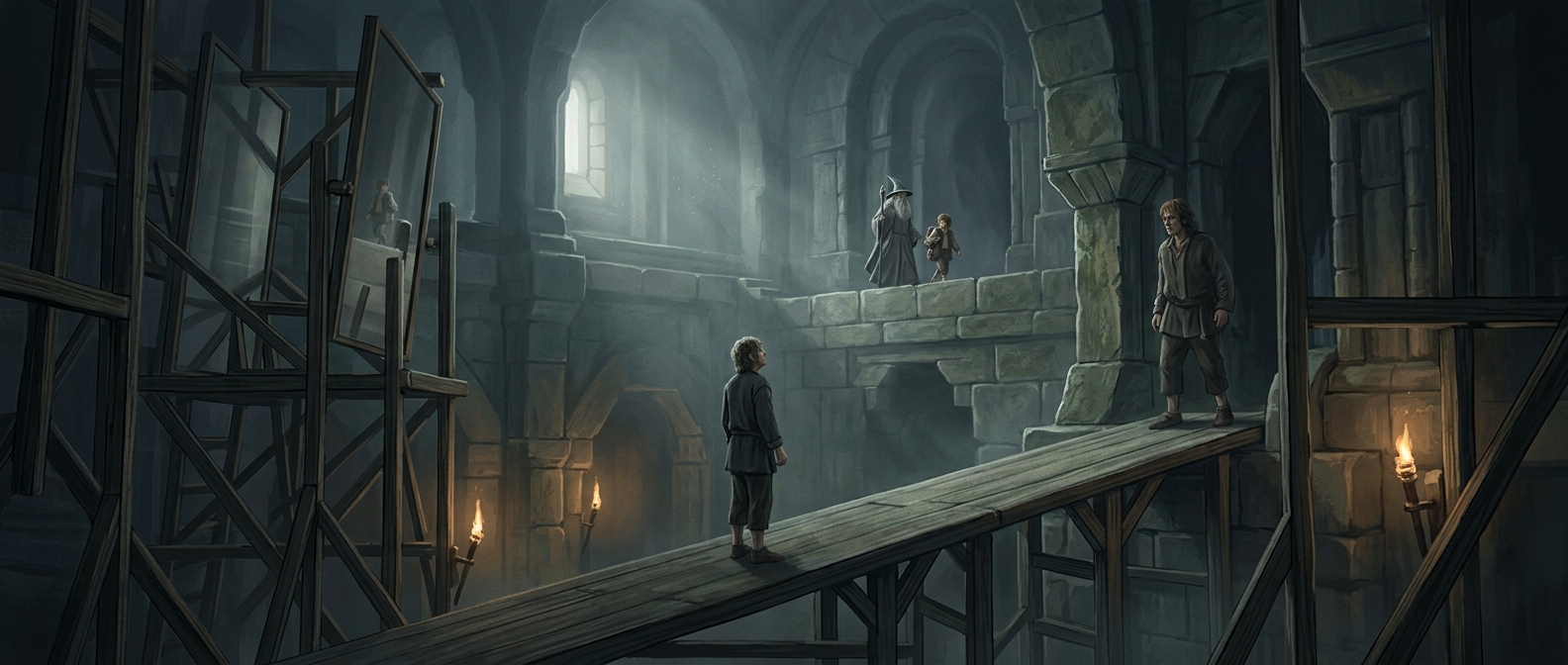
The illusion works because a camera records a flat image, not the true distances between people and objects. An actor farther from the lens appears smaller in the frame, so the filmmakers can make two actors of different apparent sizes seem to occupy the same space. The camera’s viewpoint is the key: shift it, and the carefully aligned shapes no longer match.
That makes forced perspective less like a trick actors can perform freely and more like a scene built around one precise sightline. The crew has to arrange the actors, scenery, and props so that their outlines line up from the chosen camera position. From elsewhere on the set, the arrangement may look oddly stretched or separated; the intended composition exists only through the lens.
The tradeoff: a convincing image, a constrained scene
Because the illusion relies on fixed geometry, ordinary movement can give it away. If an actor steps forward, turns unexpectedly, or reaches toward someone positioned at a different distance, the visual relationship changes. The camera, too, generally needs to stay put. That limits how freely a director can move through the scene, but it lets the finished shot preserve a sense of shared space without digitally shrinking a performer.
The method’s practical payoff is also its memorable limitation: the scene is convincing from exactly the right angle. The camera does not merely record the illusion—it is the one place where the illusion becomes real.