A parade scaled down to a tabletop
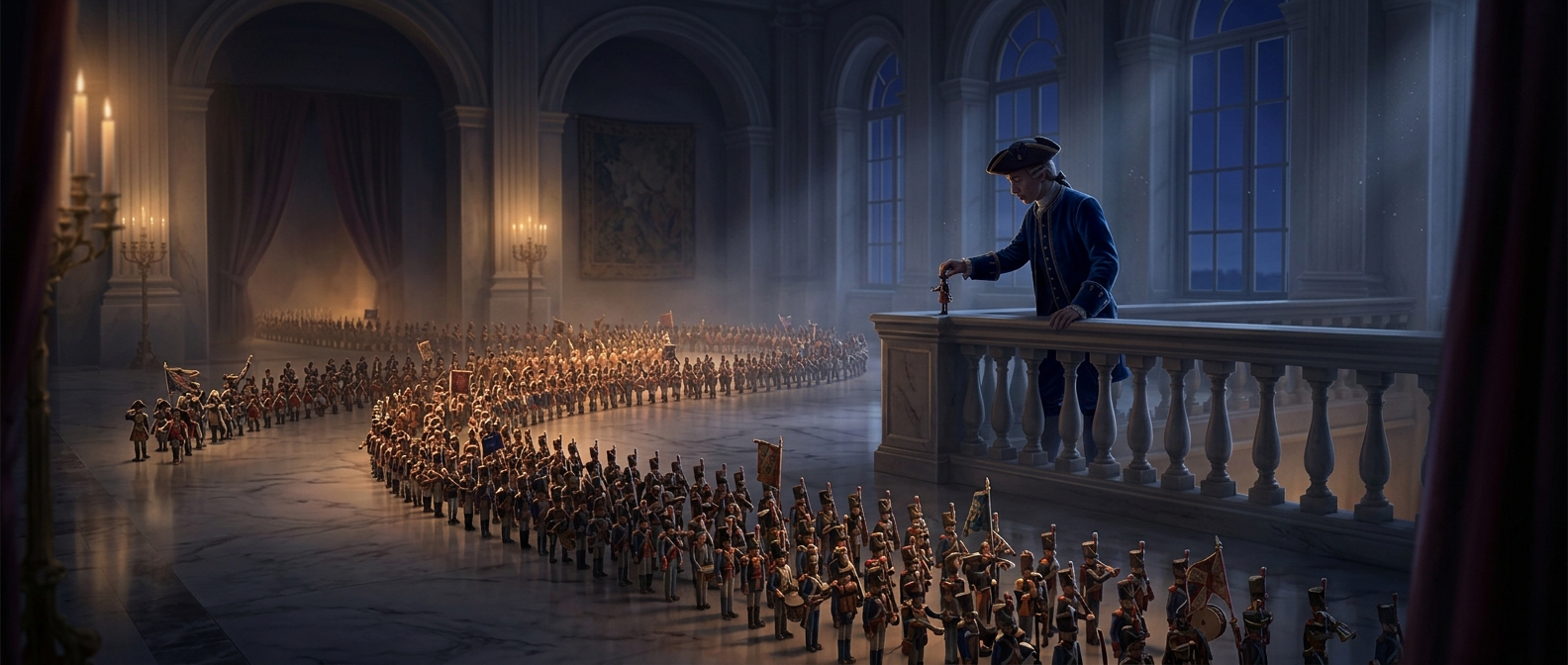
For this tsar, military drill was not confined to barracks or parade grounds. He arranged toy soldiers on a large table and moved them through formations, while real guards stood nearby in full uniform. The striking contrast was part of the scene: the tiny troops maneuvered, and the elite soldiers’ task was simply to watch.
Drill means practicing exact movements until a unit can act in unison. On a tabletop, a ruler could rearrange ranks and repeat a maneuver without moving an entire regiment. But this was not a substitute for training real troops; the guards’ presence turned private play into a formal spectacle.
When military order became a performance
Uniforms and disciplined posture made the guards part of the display, even though they did not join the miniature march. Their stillness echoed the order the toy army was meant to represent. The scene made military authority visible at two scales: in the arranged ranks on the table and in the real men standing watch beside it.
That is what makes the anecdote more than a story about an unusual pastime. It shows how thoroughly the ruler’s interest in military order shaped his surroundings: even a toy parade could have its own uniformed audience.