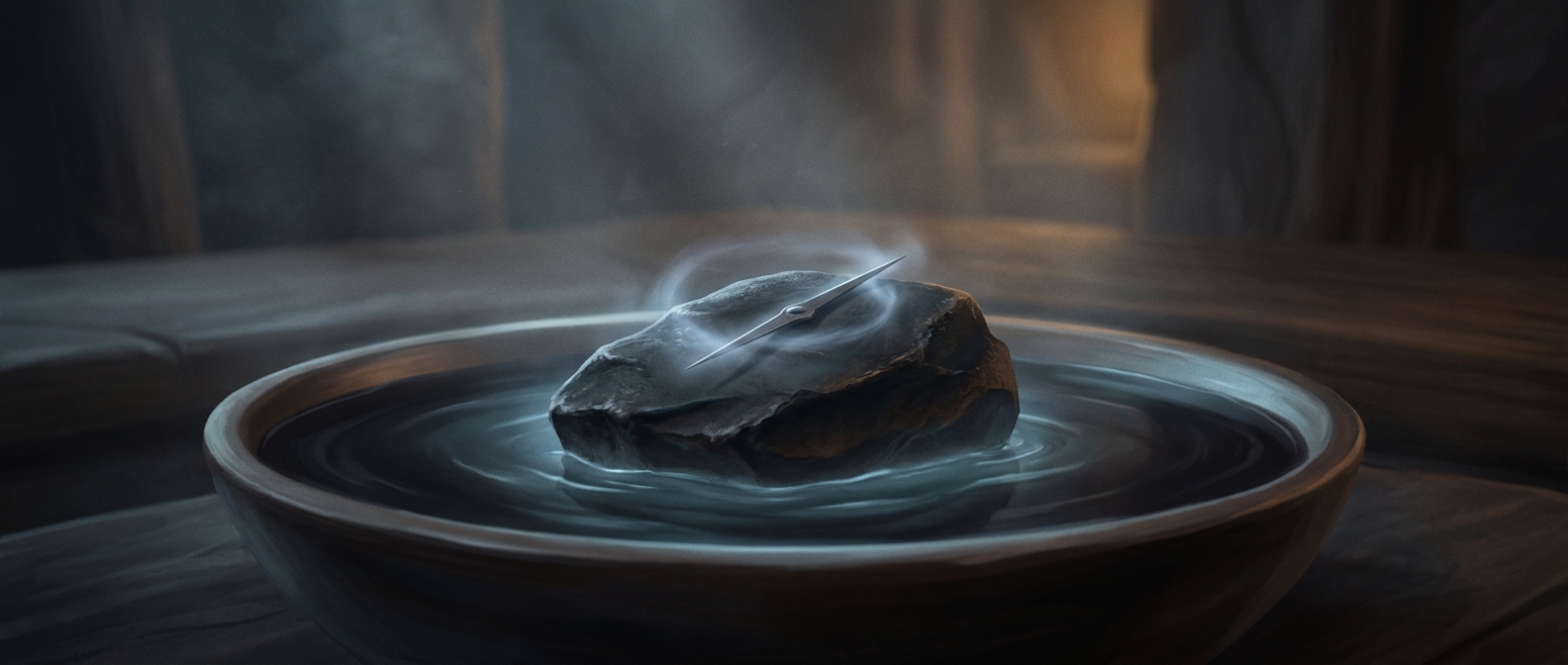
How a Stone Could Find a Direction
A naturally magnetic stone, often called a lodestone, contains iron minerals whose tiny magnetic regions are aligned. That gives the stone a north–south orientation: when it can turn freely, Earth’s magnetic field exerts a small force that nudges it into alignment.
The trick was not just finding a magnetic rock; it was letting it move. A stone resting on a table would drag against the surface and might be too heavy to turn. Set on a small piece of wood in water, it could rotate with much less resistance. The bowl held the water in place, while the floating support acted as a simple pivot.
A Useful Direction, Not a Perfect One
The stone did not point to the geographic North Pole. It aligned with magnetic north, the direction indicated by Earth’s magnetic field, which differs from true north and varies by location. The reading could also be disturbed by nearby iron or other magnets, and a rough stone might turn slowly or settle imperfectly.
Even with those limitations, the arrangement made direction available where landmarks were unreliable—on open water, in fog, or at night. It turned magnetism, otherwise invisible, into a visible motion: a stone and its wooden float slowly swiveling in a bowl until they settled along a north–south line.