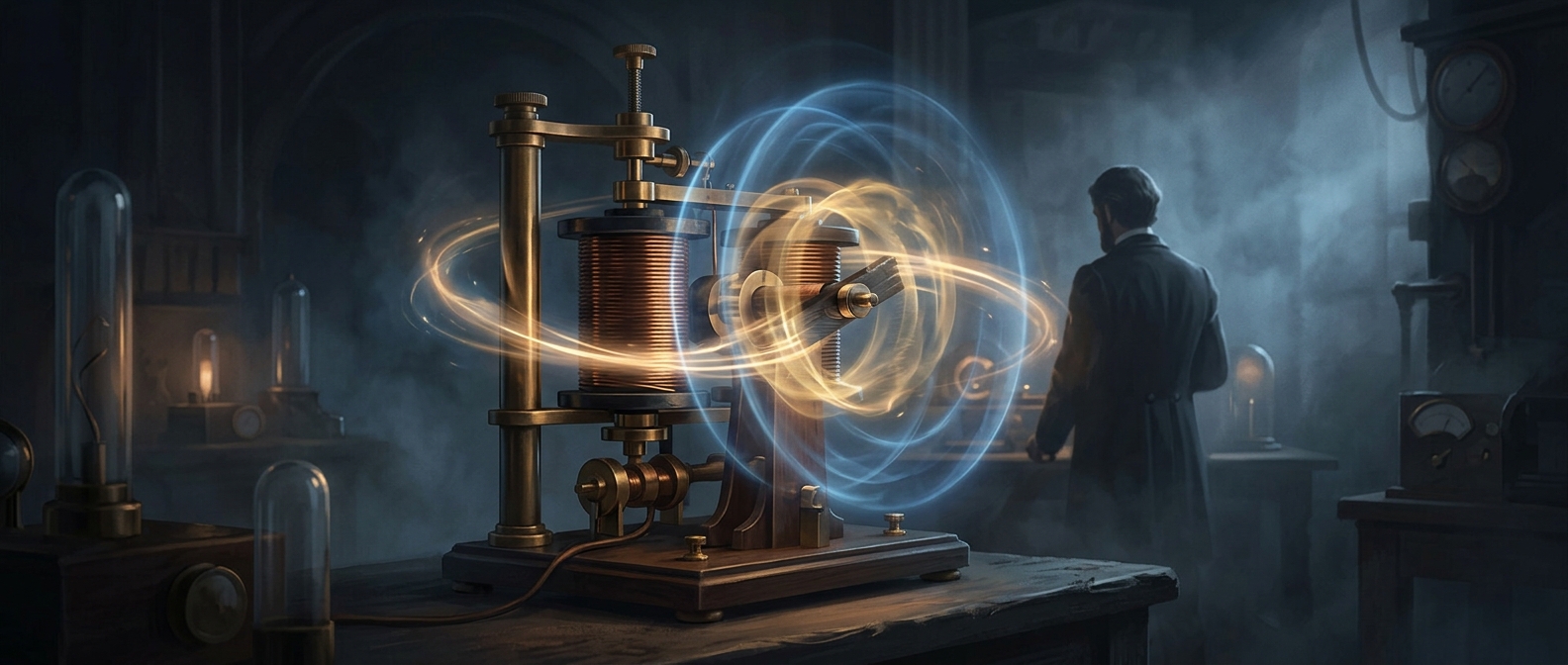
How a magnetic field could make metal move
A metal cylinder can begin spinning even when no wire or magnet touches it. The key is a rotating magnetic field: a magnetic influence that shifts direction around the cylinder rather than simply pulling from one side.
As that field sweeps past the metal, it induces tiny electric currents inside it. Those currents create their own magnetic field, which interacts with the moving one and produces a turning force. The cylinder follows the field, with a slight lag; that lag is essential because it lets the changing field keep inducing current.
From a demonstration to an AC motor
This principle became the basis of the induction motor. In a practical version, stationary coils—the stator—create the rotating field, while a conductive rotor turns inside it. Alternating current in the coils changes direction in a coordinated pattern, making the field appear to rotate continuously.
In the 1880s, inventors including Nikola Tesla and Galileo Ferraris developed motors based on this rotating-field principle. It offered a way to turn alternating current into steady mechanical rotation without the brushes and commutators used in many earlier motor designs. Those parts made electrical contact with the rotating component and could wear or spark.
The result was more than a striking trick with a metal cylinder: it showed how motion could be produced through induction, without a direct electrical connection to the moving part. That is why rotating-field induction motors became so useful for driving machinery.