How a Spinning Disk Became a Generator
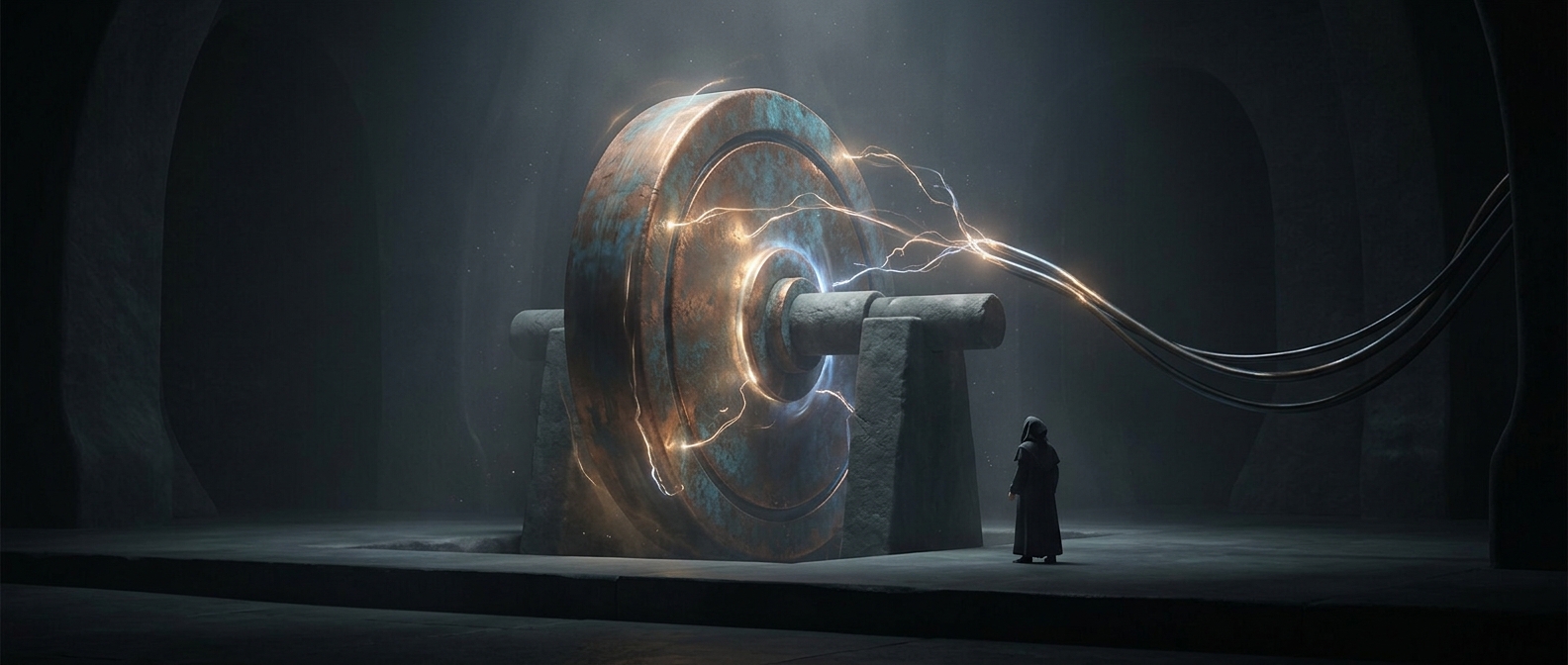
The copper disk worked because moving metal in a magnetic field pushes electric charges through the metal. As the disk turned between the magnet’s poles, this force nudged charges toward its rim, creating a voltage between the rim and the center. That separation of charge is called electromagnetic induction: motion in a magnetic field produces an electrical effect.
To draw usable current, contacts had to touch both the disk’s center and its edge. Wires connected those contacts through an external circuit, giving the separated charges a route to flow. Because the disk kept turning in the same direction, the current flowed steadily in one direction rather than reversing each half-turn.
From Demonstration to Power Source
Michael Faraday demonstrated this kind of generator in 1831, showing that electricity could be produced by motion—not only by chemical reactions in batteries. The disk therefore joined two systems: a person’s mechanical effort, delivered through a crank, and an electrical circuit outside the machine.
The design was ingenious but limited. It produced electricity at relatively low voltage, and its sliding contacts had to maintain contact with the spinning disk. Later generators used rotating coils and other arrangements that were better suited to producing and distributing useful electrical power. Still, the disk made a lasting principle tangible: keep a conductor moving through a magnetic field, and mechanical work can become electric current.