A paper roll becomes a performance
Inside a Wurlitzer Style 105 band organ, the music begins as a strip of paper with carefully placed holes. As the roll moves across a tracker bar—a row of openings beneath it—each hole lets air pass through a corresponding channel. That air activates valves, which direct the organ’s bellows-powered airflow to pipes or percussion devices. The pattern of holes determines which notes and rhythmic accents sound, and when.
The organ is therefore more than a loud player of prerecorded music: its roll is a mechanical score, and the instrument performs it without a musician pressing keys.
Why the sound carried across a midway
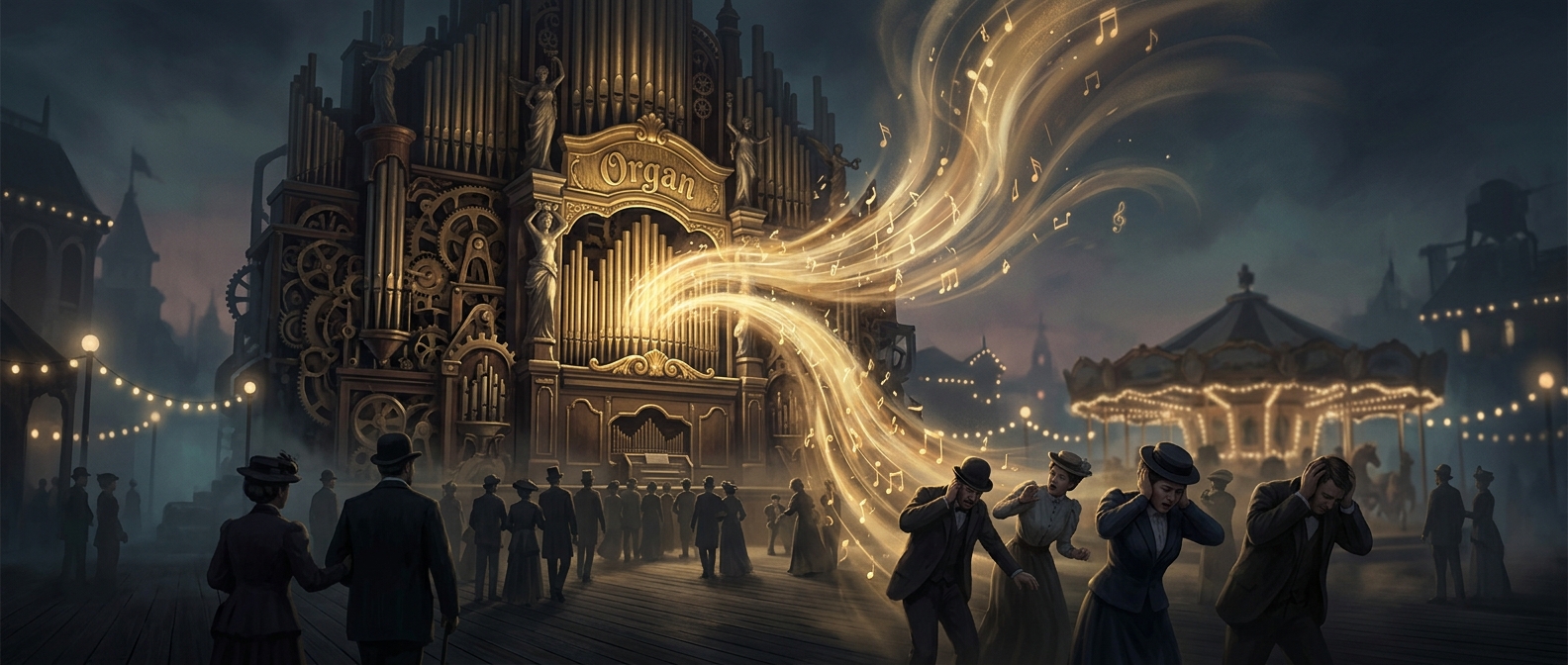
A band organ’s pipes create the bright, forceful tones associated with brass bands, while built-in percussion adds a steady beat. Together, those sounds make a dense musical signal that can remain recognizable amid the competing noise of an amusement park. The point was not subtlety; it was to make music audible in a busy public space.
That setting also shaped the music’s role. A repeating roll could provide a continuous soundtrack while a ride operated, turning machinery, motion, and music into one coordinated attraction. The organ did not need to silence the coaster. It needed to give the midway its own sound—one strong enough that riders and spectators could hear the tune between the screams.