A Small Mechanism Made for Repeated Use
A crossbow’s trigger had to hold a drawn bowstring under tension, then release it when the shooter pulled. Inside the mechanism, metal parts acted as catches and levers: one secured the string, while movement of the trigger shifted the catch out of the way. The parts had to meet at precise points. If one bent or broke, the crossbow could no longer fire reliably.
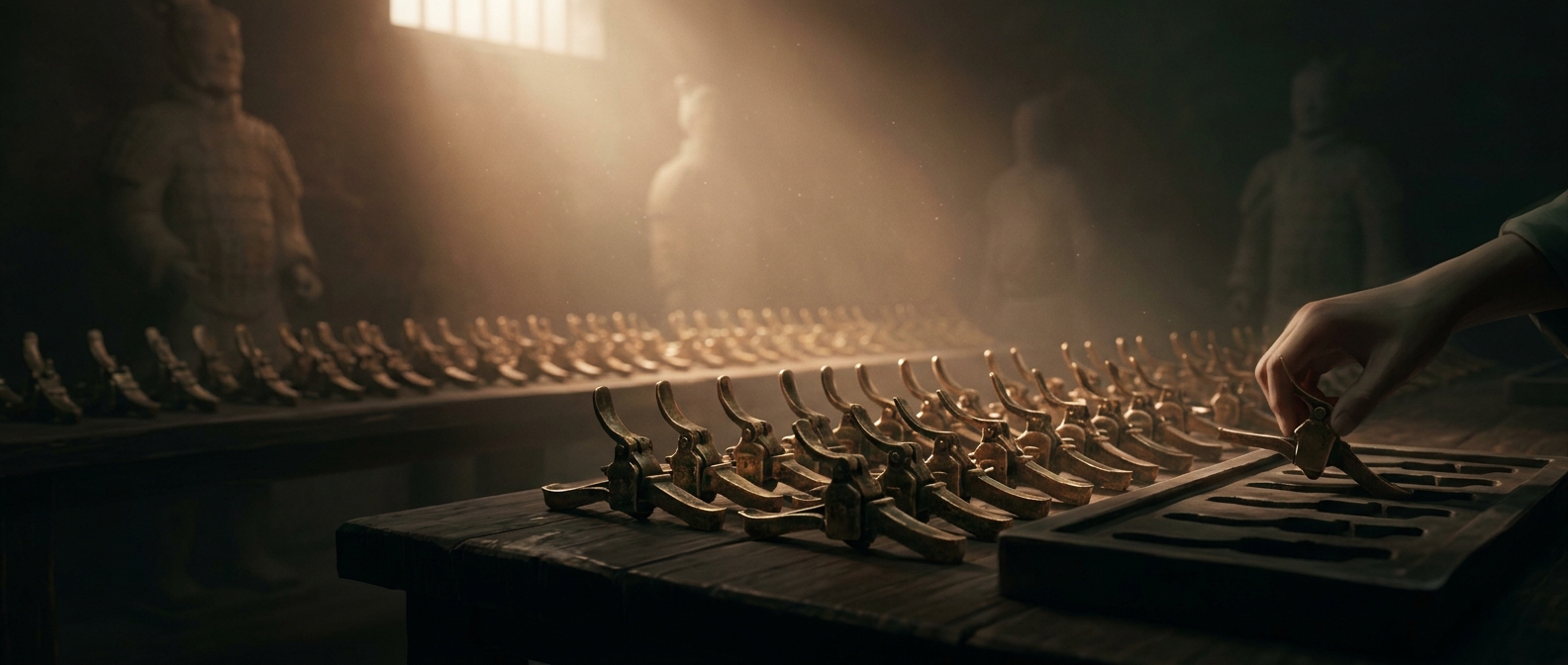
Casting bronze parts to standard dimensions made that failure easier to fix. Instead of shaping a replacement to fit one particular weapon, a craftsperson could use a part made to the same pattern. That turned repair from a one-off fitting job into a more repeatable task.
The Advantage Was in the Supply Chain
Standard sizes mattered beyond the workshop. An army maintaining many crossbows could keep compatible replacement mechanisms or parts on hand, rather than waiting for a specialist to make each repair from scratch. The approach also made it practical to produce components in batches, while leaving the weapon’s larger wooden structure to be assembled separately.
This was not modern factory production: casting still required molds, skilled labor, and careful finishing. But it applied a powerful principle—make parts alike enough that a replacement will work where the original did. On campaign, that could mean a damaged crossbow returned to service with a swap, rather than becoming unusable while a custom piece was made.