Why the Red Army wanted a gliding tank
Moving tanks to a battlefield was a problem of logistics as much as firepower. Aircraft could carry troops and supplies, but delivering a tank intact was far harder: it was too heavy for ordinary parachute drops, and landing it separately from the soldiers who needed it could waste precious time. The Soviet A-40 was an attempt to make a light tank arrive under its own armor.
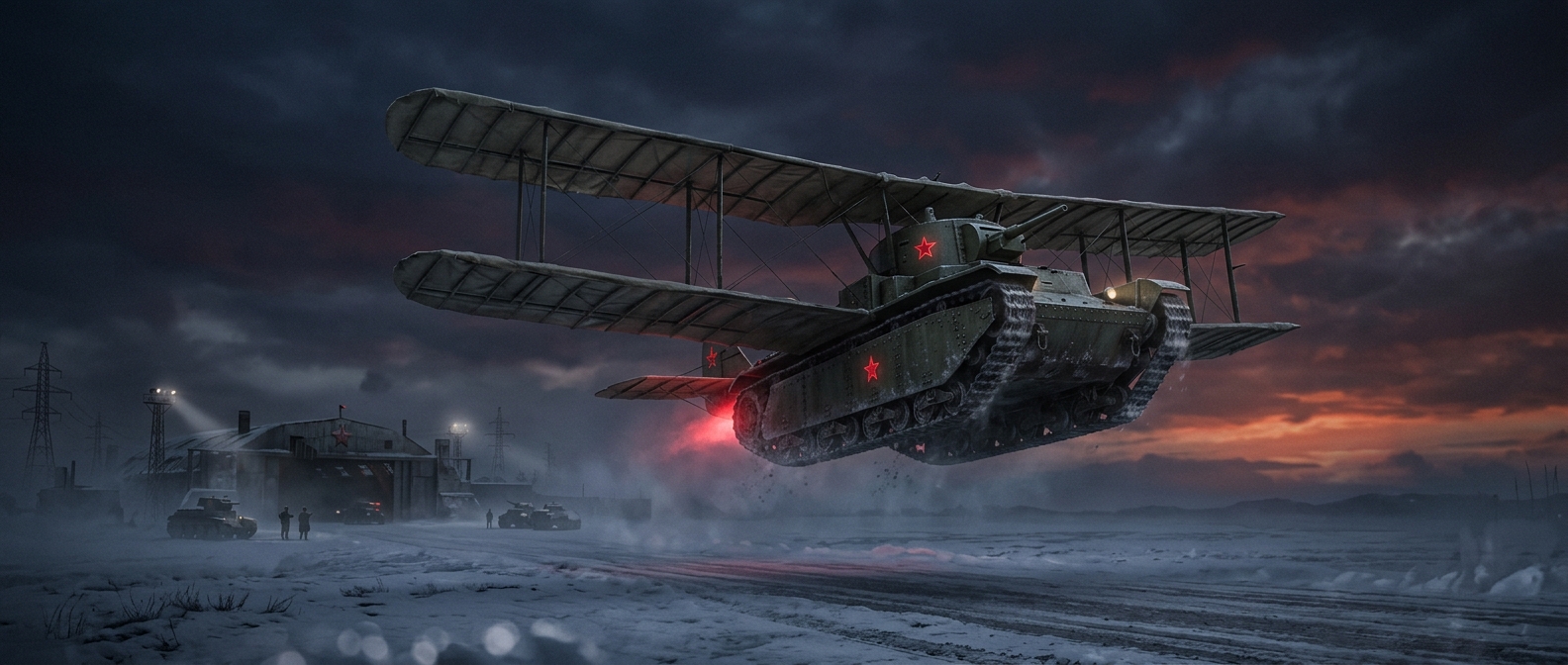
The design used a T-60 light tank fitted with a large, detachable wing-and-tail assembly. A bomber would tow the tank aloft; once released, the A-40 would glide down to a field. After landing, its flight gear could be discarded so the vehicle could move as a tank.
The weight problem became an air problem
A glider needs lift from its wings, but it also needs an aircraft powerful enough to pull it through the air. The tank’s wings and tail added drag—the resistance that an aircraft must overcome—while the armored vehicle itself was already a heavy load. That meant the tow plane had to work exceptionally hard just to keep the combination flying.
In the 1942 test, the towed A-40 proved too demanding for the aircraft. The tow plane’s engines overheated, and the pilot released the tank before it could be brought to the intended battlefield. The tank glided down, but the trial did not demonstrate a practical way to deliver armor in combat.
A landing was not enough
The idea was not defeated simply because a tank could not glide. The deeper obstacle was the whole delivery chain: the aircraft had to tow the bulky load safely, release it near the target, and leave the tank ready to fight. If the tow aircraft could not manage the load, the rest of the plan did not matter.
The A-40 therefore remained an experiment rather than a transport system. Its brief flight exposed a hard limit in airborne armor: a tank could be given wings, but those wings did not make it light enough for the aircraft available to carry it.