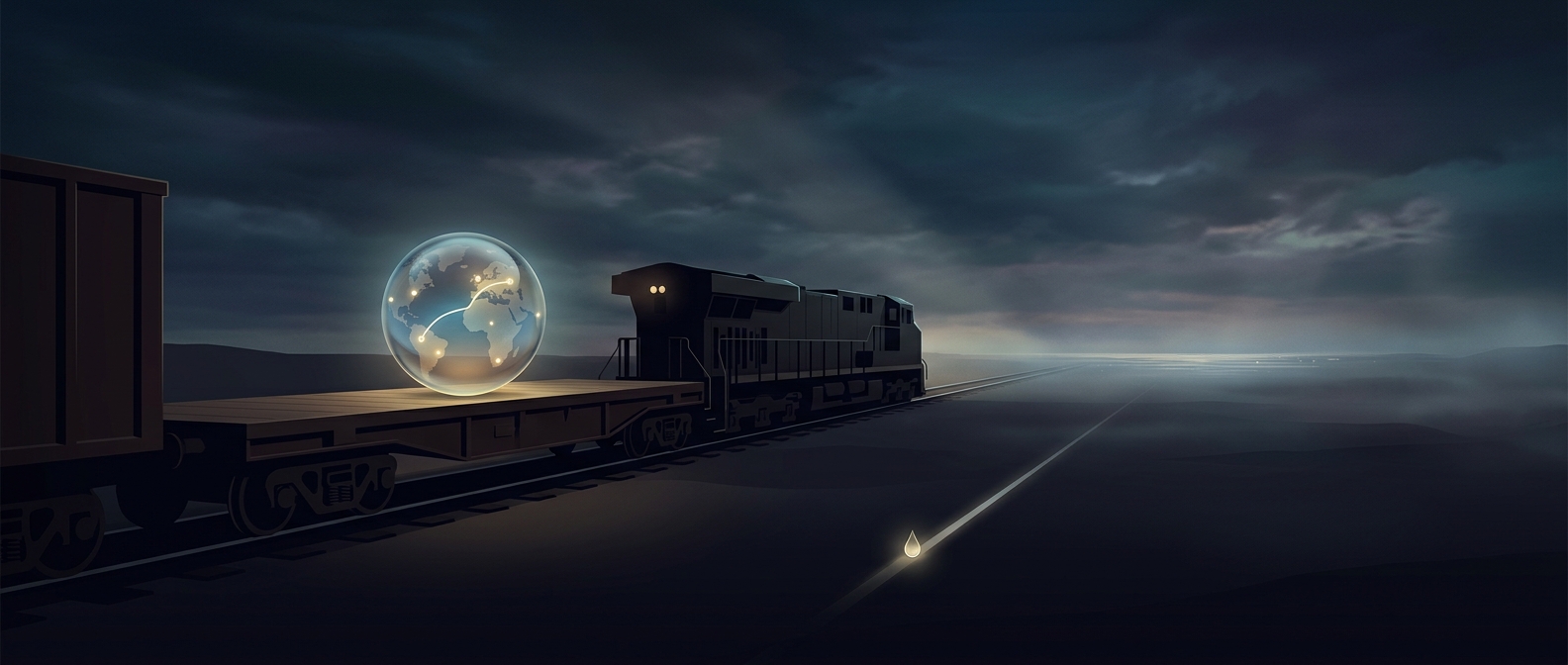
Why a Train Can Move So Much Freight on So Little Fuel
A freight train’s efficiency begins at the point where wheel meets track. Steel wheels touch steel rails along a very small area, and the wheels roll rather than scrape along the ground. That creates far less resistance than dragging a load or carrying it on rubber tires, where the tires continually flex against the road.
The advantage grows with the size of the load. One locomotive can pull many coupled cars, so its fuel use is shared across a long line of freight instead of being spent moving a separate engine and vehicle for each load.
Diesel Power, Delivered Electrically
In a diesel-electric locomotive, the diesel engine does not usually drive the wheels through a conventional gearbox. It turns a generator, and electricity from that generator powers motors mounted at the wheels. Those motors provide the force needed to start and pull the train, while the engine supplies energy along the way.
This arrangement lets the locomotive apply substantial pulling force at low speeds, when a heavy train is getting underway. Once moving, the train’s momentum helps keep it rolling; the engine mainly has to replace energy lost to resistance and keep the cars moving.
The Tradeoff Is in the Route
Low rolling friction is not the only force at work. Air pushes against the train, and climbing a grade requires extra energy to lift the freight. Starting and stopping also take energy, which is why a long, steadily moving freight train can use fuel more efficiently than one repeatedly slowed or sent over steep terrain.
So the striking distance-per-gallon figure depends on hauling a large load over a route where the train can keep rolling. Its practical lesson is that moving freight efficiently is not just about a powerful engine: it is about spreading that engine’s work across many tons and avoiding needless resistance.