A Monopoly board built for the plaza
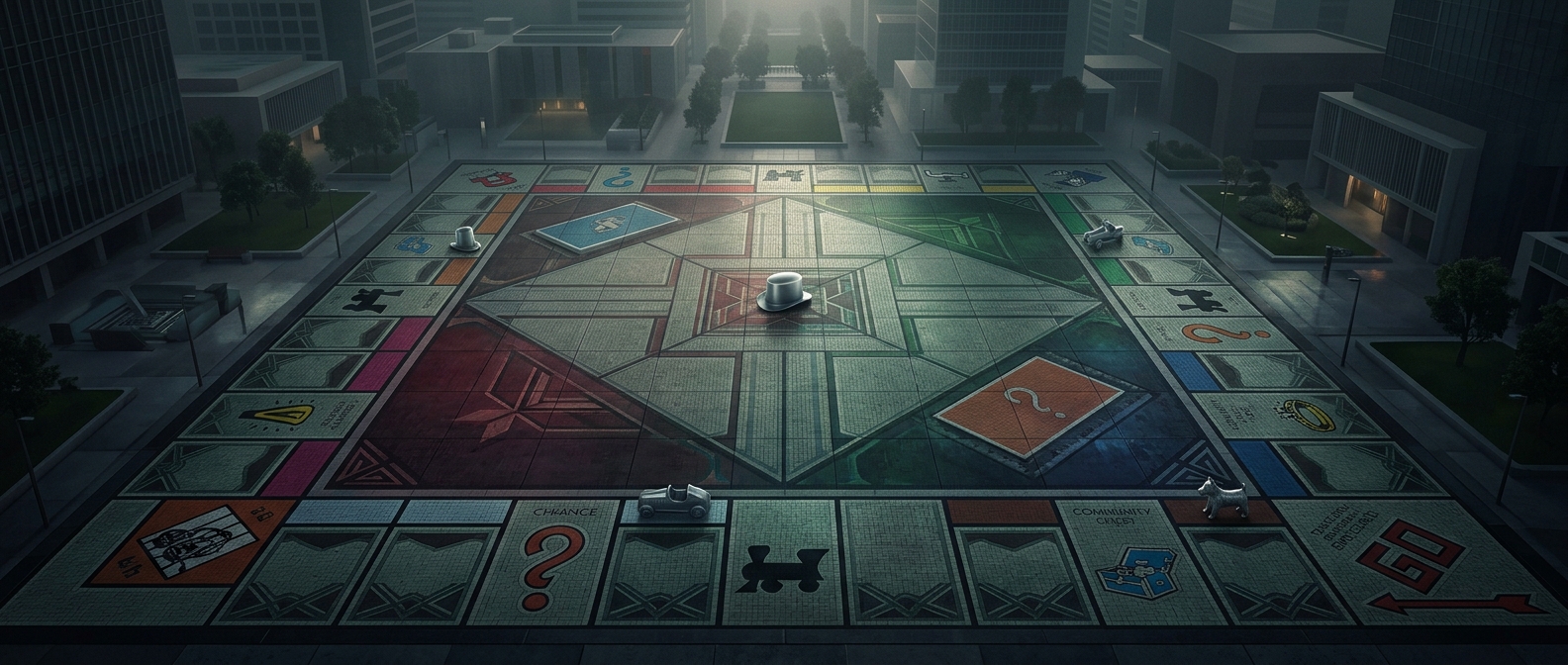
San Jose’s giant Monopoly board turns a tabletop game into a walk-around attraction. Set into a public plaza, its squares are made of granite, so the board is part of the site rather than a temporary game laid out for an event. Players move through the familiar properties and corners on foot, making the board’s scale part of the play.
Why make a game this large?
Monopoly depends on seeing the whole board at once: players track properties, money, and movement around a loop. Enlarging that loop changes the social experience without changing the basic structure. Instead of leaning over a table, players become visible pieces in a shared public space; oversized token hats help make each person’s role legible to spectators, while jumbo dice preserve the familiar roll-and-move turn.
The granite construction also makes permanence practical. A conventional board can be folded away, but a stone installation is designed to remain in place and withstand outdoor use. That turns a recognizable game into a landmark people can encounter even when nobody is playing.
A record that changes the scale of play
Built in 1992, the San Jose installation holds the Guinness World Record for the largest permanent Monopoly game. The distinction is specifically about a permanent game—not simply the largest Monopoly board ever assembled. Its most memorable effect is simpler: a game usually measured in inches becomes a route across a plaza, with players walking their turns instead of merely watching a token move.