A boundary treaty left San Juan Island in limbo
The pig dispute mattered because the island’s national ownership had never been settled clearly. The 1846 Oregon Treaty set the boundary between British and American territory along the 49th parallel and then through the channel separating the mainland from Vancouver Island. But several channels wound through the San Juan Islands, and the treaty did not make clear which one the boundary followed.
That ambiguity left both Britain and the United States claiming the islands. American settlers and the British Hudson’s Bay Company were living and working there, so a quarrel over property could quickly become a test of whose laws—and whose flag—would prevail.
A local shooting became a test of sovereignty
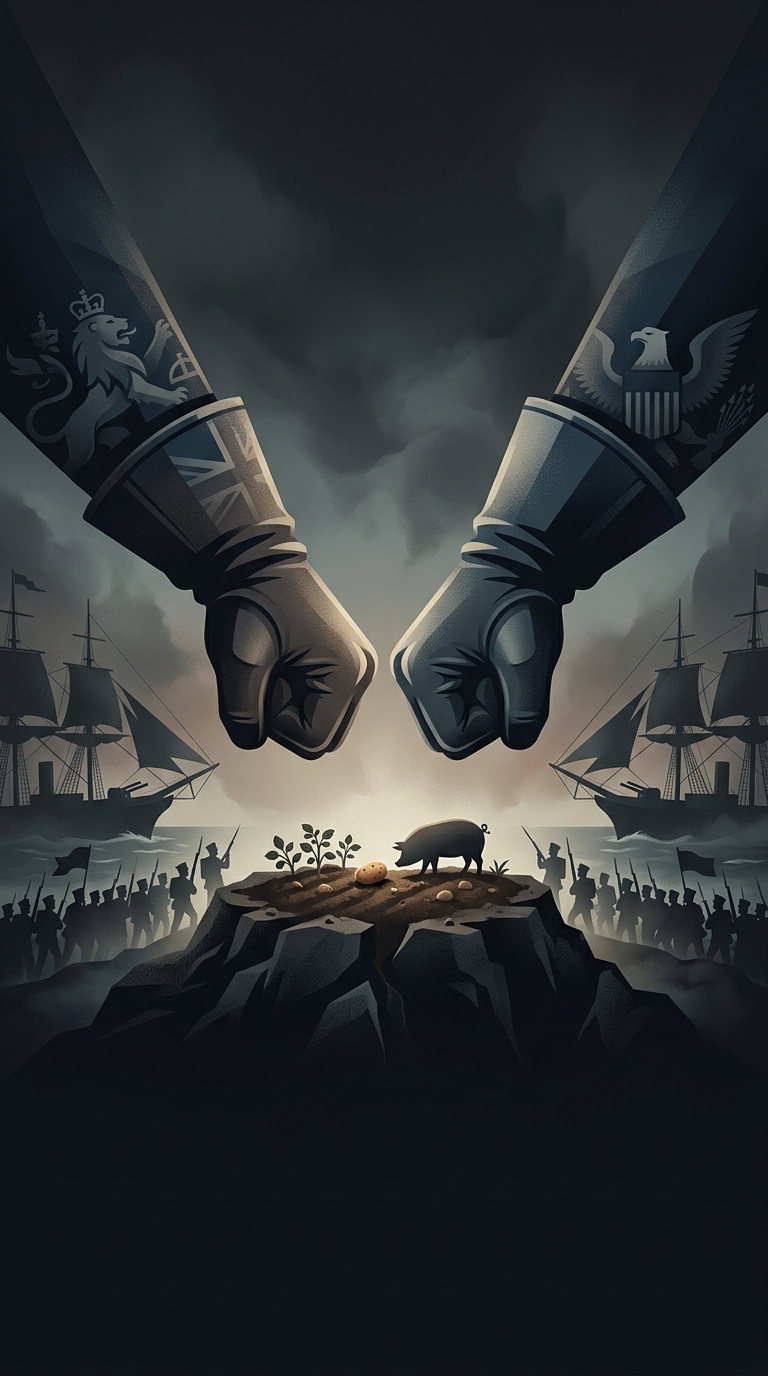
In 1859, American farmer Lyman Cutlar shot a pig belonging to the Hudson’s Bay Company after it damaged his potatoes. The argument that followed was not simply about compensation: British authorities could treat the shooting as an offense under British jurisdiction, while the American settlers resisted being governed by a British company and its officials.
As both governments sent forces to the island, commanders faced a dangerous imbalance between the small incident that had started the dispute and the much larger conflict it could trigger. Neither country wanted a war over an unresolved map, but backing down without settling the claim risked making its rival’s authority look established.
Joint occupation bought time for diplomacy
The immediate solution was to keep the rival claims alive without letting either side take exclusive control. British and American forces occupied the island together while diplomats continued to address the boundary question. This arrangement contained the crisis, but it did not decide who owned the land.
The issue was eventually submitted to international arbitration. In 1872, Kaiser Wilhelm I of Germany ruled that the boundary ran through Haro Strait, placing San Juan Island on the American side. The pig had exposed a flaw in a treaty’s geography; the eventual decision settled it without turning a farmyard dispute into a war.