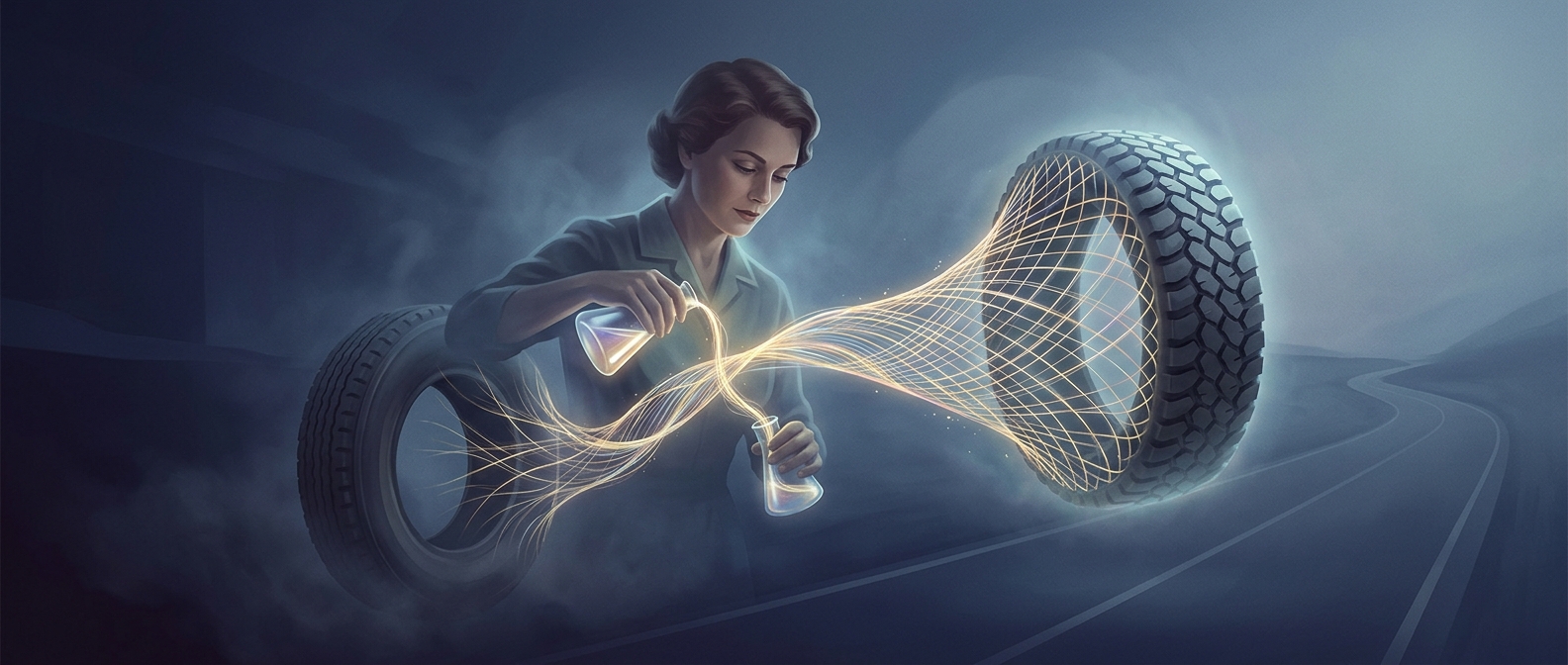
How Kevlar’s molecules became a strong fiber
The breakthrough was not simply a tougher chemical recipe. Stephanie Kwolek noticed that an unusual polymer mixture behaved differently from the solutions used to make ordinary fibers: it was cloudy and unusually thin, yet it could be spun into a remarkably strong thread. Rather than discard it, she persuaded colleagues to test what it could become.
The material was a liquid-crystalline polymer—a solution in which long molecules tend to line up in the same direction. During spinning, that alignment carries into the finished fiber. Because the polymer chains run largely along the fiber’s length, they resist being pulled apart instead of behaving like a tangled mass. The result is a fiber with high tensile strength, meaning it can withstand substantial pulling force for its weight.
From a tire cord to protective layers
That strength-to-weight combination suited the original goal: reinforcing radial tires without relying on heavy steel. The fiber could also serve where weight and resistance to tearing mattered more than tire design. DuPont developed the material commercially as Kevlar, and its uses expanded into protective equipment and other products.
In body armor, Kevlar works as part of a layered system, not as an impenetrable sheet. Tightly woven fibers catch and deform a projectile, spreading its force across a wider area and slowing it. The vest must still absorb the impact, and protection depends on the armor’s construction and the threat it is designed to resist.
The surprising turn was that a search for lighter tire reinforcement produced a material useful wherever strong fibers can replace heavier ones. A mixture that looked wrong for conventional fiber-making became the starting point for a technology built around molecular alignment.