A failed attack left the route exposed
On June 28, 1914, a group of Bosnian Serb conspirators planned to kill Archduke Franz Ferdinand, heir to Austria-Hungary’s throne, during his visit to Sarajevo. The first attempt that morning failed: a bomb thrown at the archduke’s car bounced off and exploded beneath a following vehicle. Franz Ferdinand continued with the visit, then decided to go to the hospital to see the people injured in the blast.
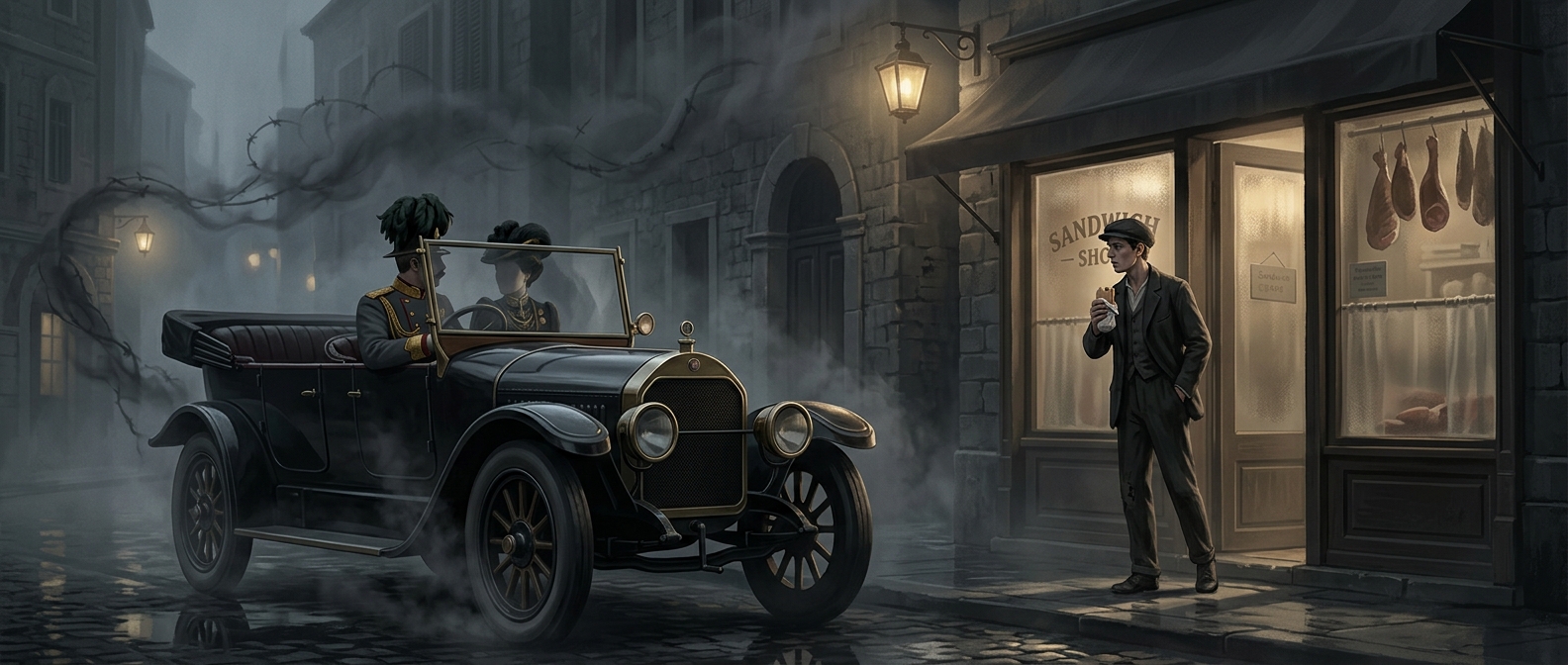
That change of plan mattered. The driver had not been given the updated route clearly. As the motorcade turned onto a street it was not supposed to take, officials called for the car to reverse. It stopped briefly while the driver tried to maneuver it.
Princip’s chance came from confusion
Gavrilo Princip, one of the conspirators, was nearby. He had not caused the car to stop; the route confusion put the archduke’s car within reach. Princip fired at Franz Ferdinand and his wife, Sophie, killing them both.
The episode was a collision of deliberate planning and chance. The conspirators had arranged an attack, but the first attempt had failed. A changed itinerary, poor communication, and a mistaken turn then created an unexpected opening. The assassination succeeded not because the plan unfolded smoothly, but because its failure left the target exposed to a second opportunity.
From Sarajevo to a European crisis
The killings did not automatically make a world war inevitable. They did give Austria-Hungary a reason to confront Serbia, which it held responsible for the plot, and set off a diplomatic crisis. Governments made demands, issued ultimatums, and mobilized forces while bound by rival alliances and strategic fears. Within weeks, a conflict between Austria-Hungary and Serbia widened as other powers entered the war.
The wrong turn became consequential because it happened at a moment when political leaders were already prepared to treat the assassination as a test of power and credibility. A brief pause on a Sarajevo street helped ignite a crisis that diplomacy failed to contain.