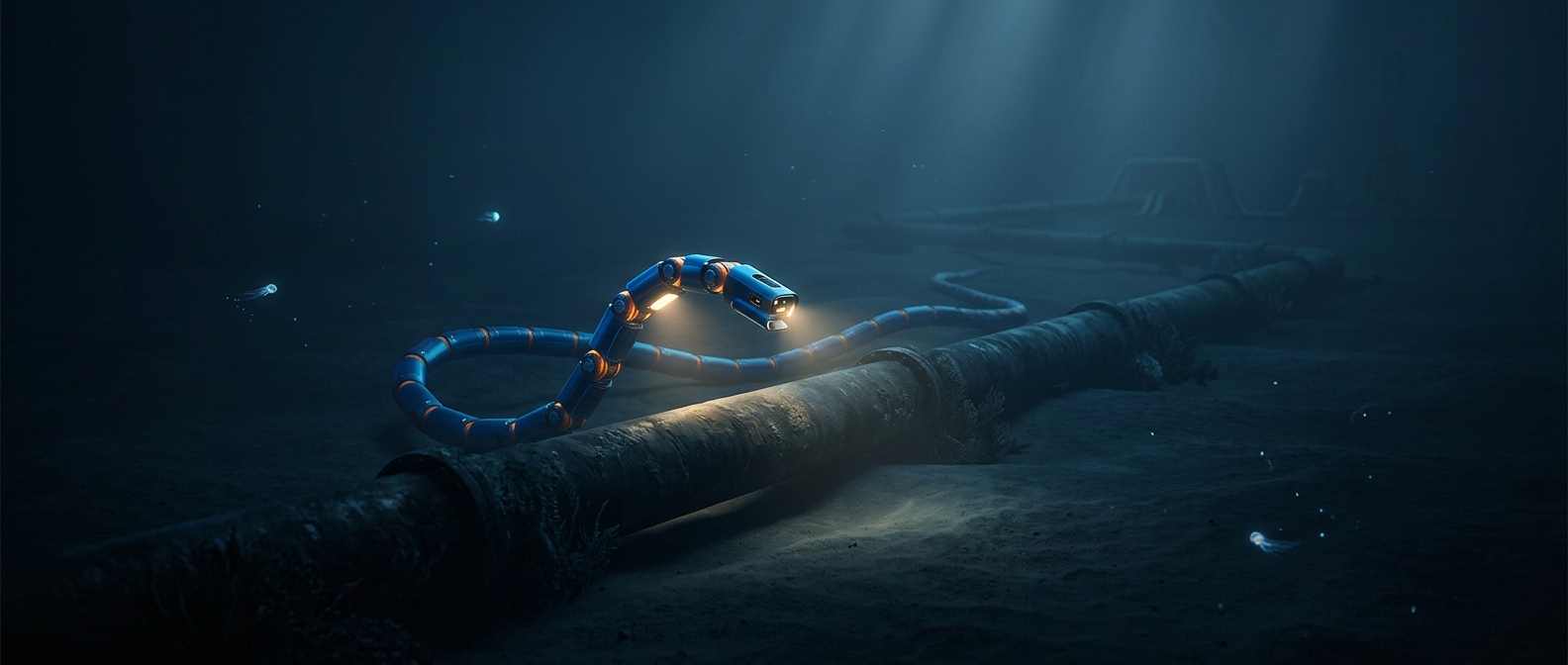
Why a Snake Shape Works Underwater
A wheeled vehicle needs a reasonably firm, continuous surface to roll across. The seafloor often offers the opposite: soft sediment that gives way under a wheel, scattered rocks that block its path, and pipes or other equipment with narrow gaps around them. A long, segmented robot can meet that terrain differently. It bends section by section, changing its shape to follow the ground or wind around an obstacle instead of trying to drive straight over it.
Movement by Changing Shape
Rather than relying on one large chassis, a snake robot uses connected sections that can be steered relative to one another. Coordinated bends produce a traveling wave along the body; as different sections push against the bottom, the robot advances. That flexibility also lets it turn in cramped spaces and keep contact with uneven surfaces, where a rigid machine may rock, snag, or lose traction.
Underwater, the robot is not swimming like a snake. It is crawling along the seafloor, using contact with the terrain to move. That distinction matters: the design is useful precisely where an inspection machine needs to approach equipment closely rather than float past it.
A Different Kind of Inspection Crew
Pipes, cables, and underwater structures can be difficult to examine from a distance, especially where parts are hidden behind supports or surrounded by debris. A flexible robot can follow their contours and reach tight areas that are awkward for a larger vehicle. Its body can carry inspection equipment close to the surface being examined, while its small, controlled movements help it work around obstacles rather than treating them as impassable.
The tradeoff is that a snake robot must coordinate many moving sections, and crawling depends on finding enough grip against the bottom. But where wheels bog down or a rigid frame cannot fit, the robot’s most useful tool is its ability to change shape to suit the route. That lets maintenance crews inspect places on the ocean floor that a conventional vehicle may not be able to reach.