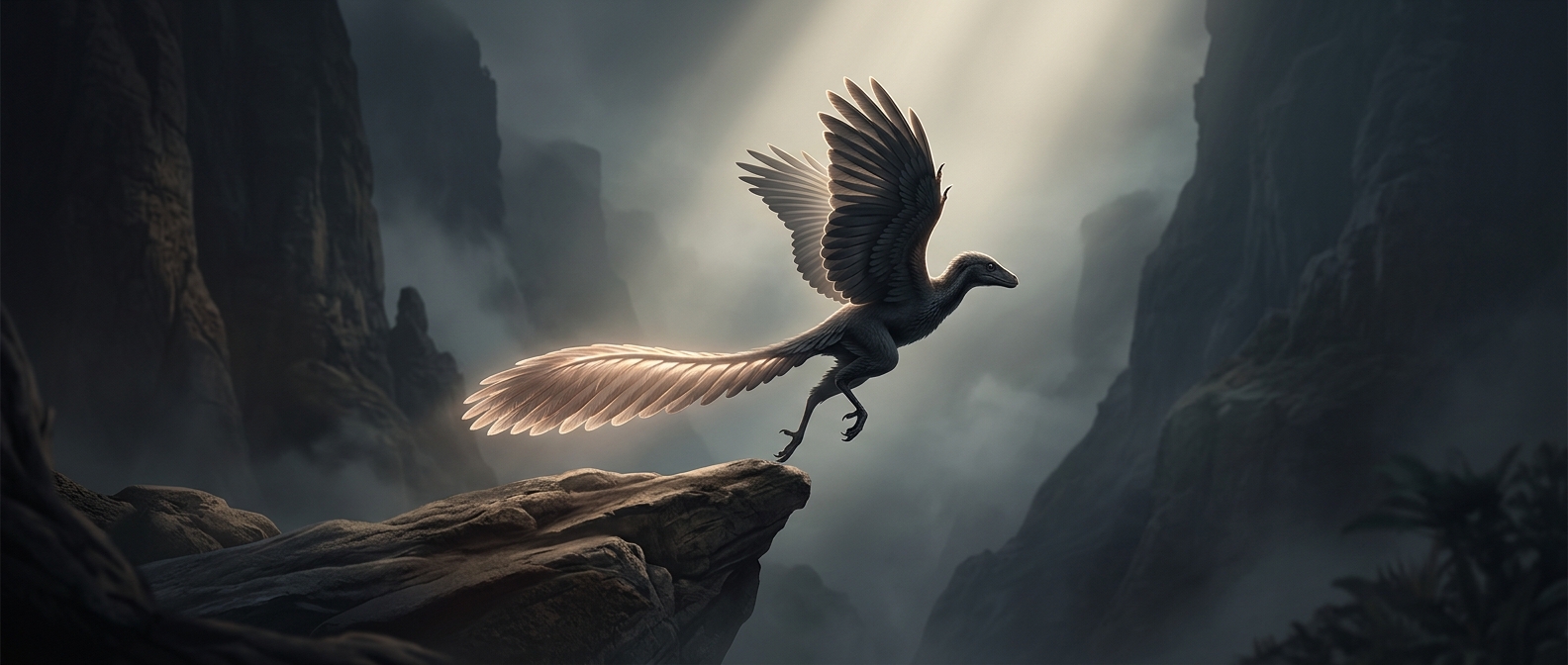
Feathers show flight equipment, not flight performance
Archaeopteryx’s wing feathers were organized into broad, overlapping surfaces much like the flight feathers of modern birds. Those feathers could help generate lift and control movement through the air. But having aerodynamic wings does not, by itself, reveal how forcefully an animal could flap, how long it could stay aloft, or how it took off.
Flight depends on more than feathers. Muscle power and the shape and mobility of the shoulder and wing bones affect how much thrust an animal can produce. Fossils can preserve bones and feather impressions, but they cannot directly show a living animal’s muscle strength or movement.
A birdlike wing on a dinosaur-like body
Archaeopteryx also had a long, bony tail and other traits associated with dinosaurs. Its tail may have helped with balance and steering, but its presence does not settle how the animal flew. The combination of features is important: it shows that elaborate flight feathers existed in an animal whose body had not yet acquired the full set of features seen in modern birds.
That makes Archaeopteryx evidence for an early stage in the evolution of birdlike flight, not a complete record of how flight worked. Its anatomy can constrain possible movements, while still leaving room for different interpretations of its performance.
What the fossils leave open
A strong flier might have powered flight; a less capable one might have managed short bursts or relied more on gliding. The preserved wings make movement through the air plausible, but the bones and feathers alone cannot distinguish those possibilities with certainty.
The key distinction is between having flight-capable equipment and knowing how well it worked. Archaeopteryx preserves the first; its exact flight style remains beyond what the fossils can demonstrate.