What a Palaeomastodon skull can—and cannot—show
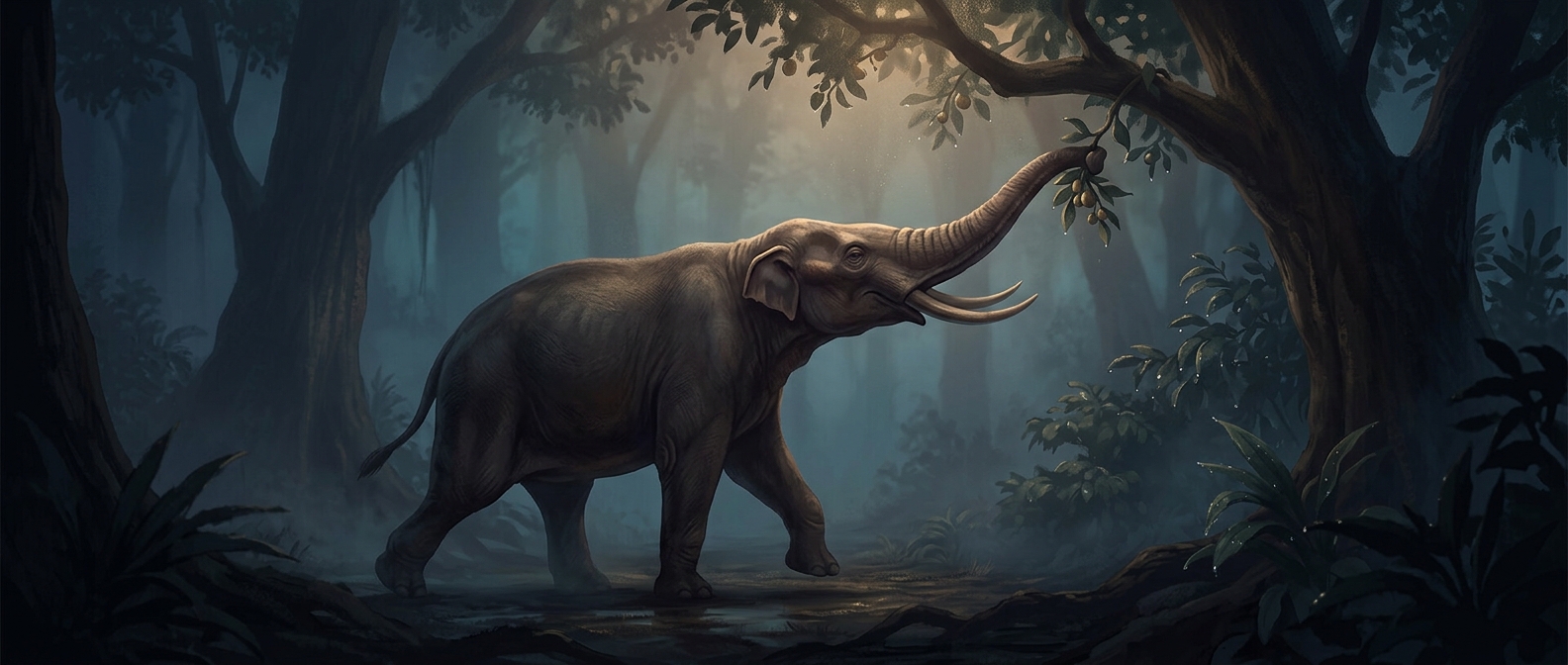
Palaeomastodon lived millions of years before modern elephants and belonged to an early branch of the proboscideans, the group that includes elephants and their extinct relatives. Its skull has an unusually long snout region, evidence that the front of the face was already changing. That makes the fossil useful for tracing how elephant-like noses may have developed—but it does not preserve a working trunk.
Bone can reveal where muscles attached and how the face was built. It cannot show the full shape, reach, or dexterity of soft tissue. A trunk is made from the nose and upper lip, which leave no direct fossil record in the way a skull does. So a long bony snout is a clue to changing anatomy, not proof that Palaeomastodon had the flexible, grasping appendage of a living elephant.
Evolution leaves clues, not a finished blueprint
The transition to a trunk was not necessarily a single leap from an ordinary nose to a modern one. Across proboscideans, changes in skull shape and the position of the nasal opening can help researchers infer how the face was reorganized. Those clues must be interpreted alongside fossils from related species; no one skull captures every stage, and evolution does not proceed as a simple ladder toward today’s animals.
A longer, more mobile nose could help an animal reach food, but fossils alone cannot establish exactly how Palaeomastodon used its snout. The striking point is the gap between what survives and what mattered in life: the skull records the changing framework, while the soft, flexible tissues that would have made a trunk useful vanished long ago.