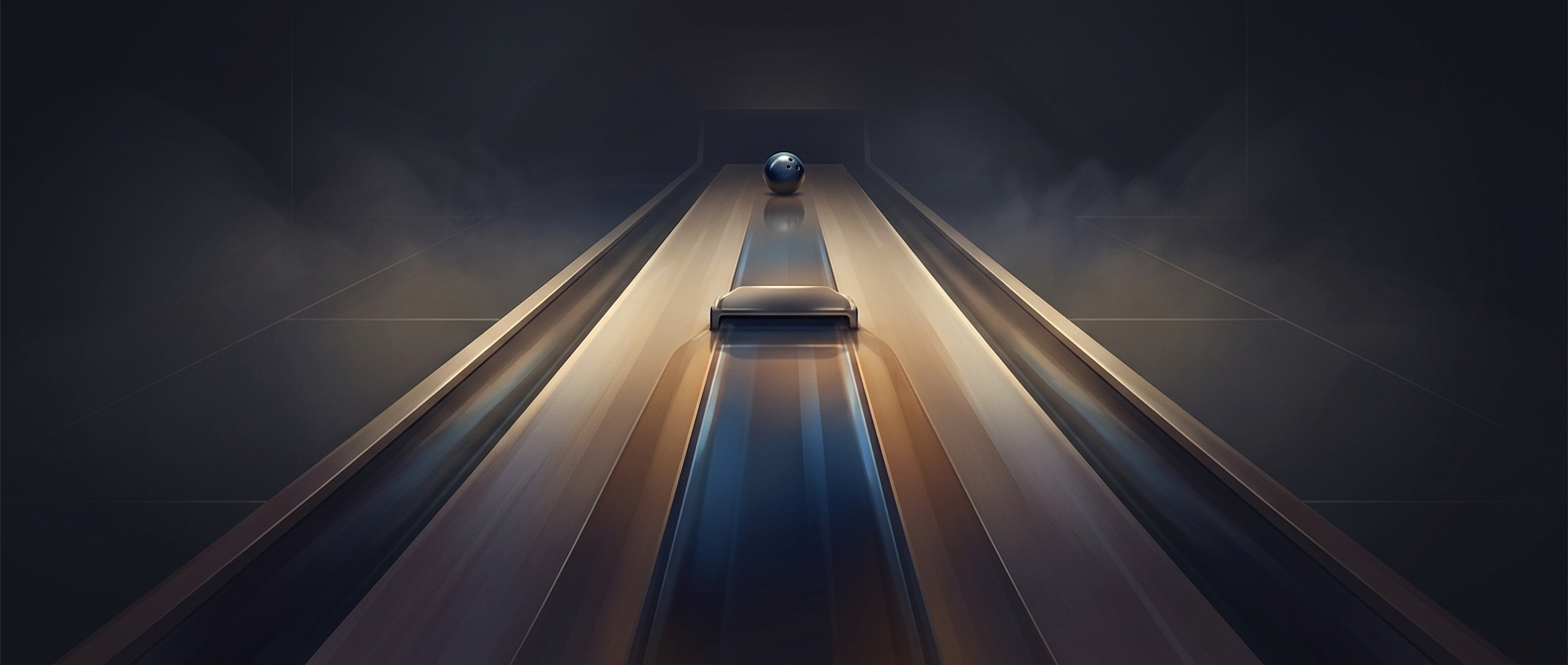
How Lane Oil Changes a Ball’s Path
A bowling ball does not turn simply because it crosses from oil onto a dry patch. The change comes from friction. On an oiled part of the lane, the ball grips the surface less, so it tends to keep sliding. When it reaches a drier area, friction increases and the ball’s rotation can begin pulling it onto a curved path—a hook.
That response depends on the ball’s rotation and direction of travel. Oil does not aim the ball at the pins; it changes how strongly the lane can influence the ball as it rolls.
Why the Middle-to-Edge Pattern Matters
Many common lane patterns place more oil through the middle and less near the edges. For a right-handed bowler, a shot that drifts too far right may reach the drier edge and gain enough friction to hook back toward the pocket, the gap between the head pin and the pin beside it. A shot that lands farther inside can stay on the oil longer and slide instead of turning as sharply.
This creates a useful margin for error, but not a guarantee. The ball still has to reach the right part of the lane with suitable speed and rotation. A badly missed shot, or one with the wrong angle, may not recover.
A Surface Treatment and a Playing Condition
Lane conditioner, commonly called oil, also limits friction between the ball and lane. It helps protect the surface from repeated impacts while giving lane operators a way to shape how balls travel. Different oil patterns can make the same lane play very differently, so bowlers adjust their starting position, target, and equipment as they learn how the ball is responding.
As balls pass, they carry some oil down the lane and leave other areas drier. The pattern therefore changes during play. The lane’s built-in forgiveness is not fixed: the route that helped one shot recover may become less reliable as traffic reshapes the oil.