A painting made through a narrow opening
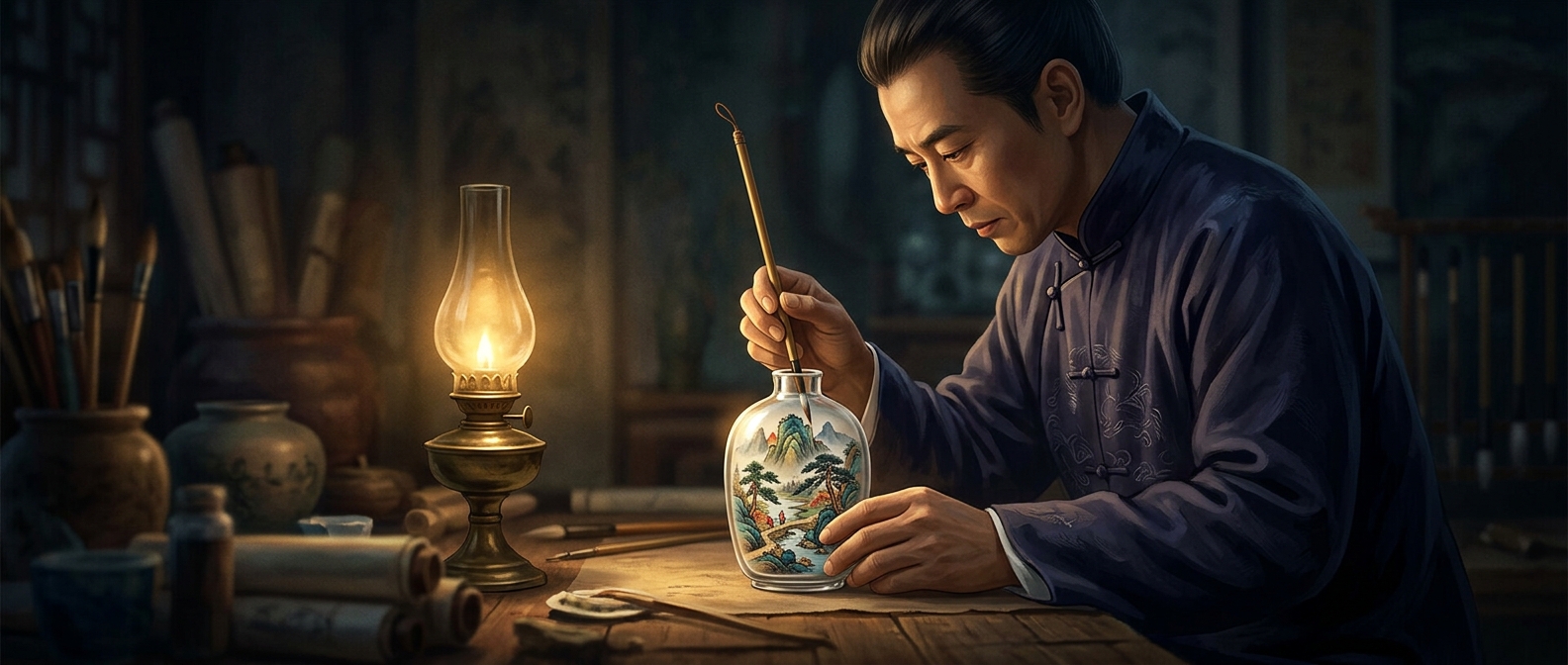
An inside-painted bottle turns a familiar task inside out. The artist cannot lay a hand on the picture’s surface: the glass wall stands between the brush and the viewer, and the bottle’s neck limits how far a tool can reach. A brush with only a few hairs can fit through the opening and make fine marks, while its bend lets the painter angle the tip against the inner wall.
The artist must also work while looking through the glass. That changes how a stroke appears: the curved bottle can shift and distort the view, and the painter has to judge the image from the outside even as the brush moves on the inside. Every detail depends on controlling a tool that is partly hidden from sight.
Skill under constraint
Landscapes and calligraphy demand different kinds of precision. A landscape asks for marks that suggest depth and forms; calligraphy depends on the shape and movement of each stroke. Inside a small bottle, both must be composed within a cramped, curved space rather than on an open sheet.
The restriction is what makes the work so striking. The artist cannot simply reach in to correct a line or turn the surface toward the light. The finished image is visible through the bottle, but its making required navigating the space behind that image—one careful, angled stroke at a time.