Why the Moon can cover the Sun
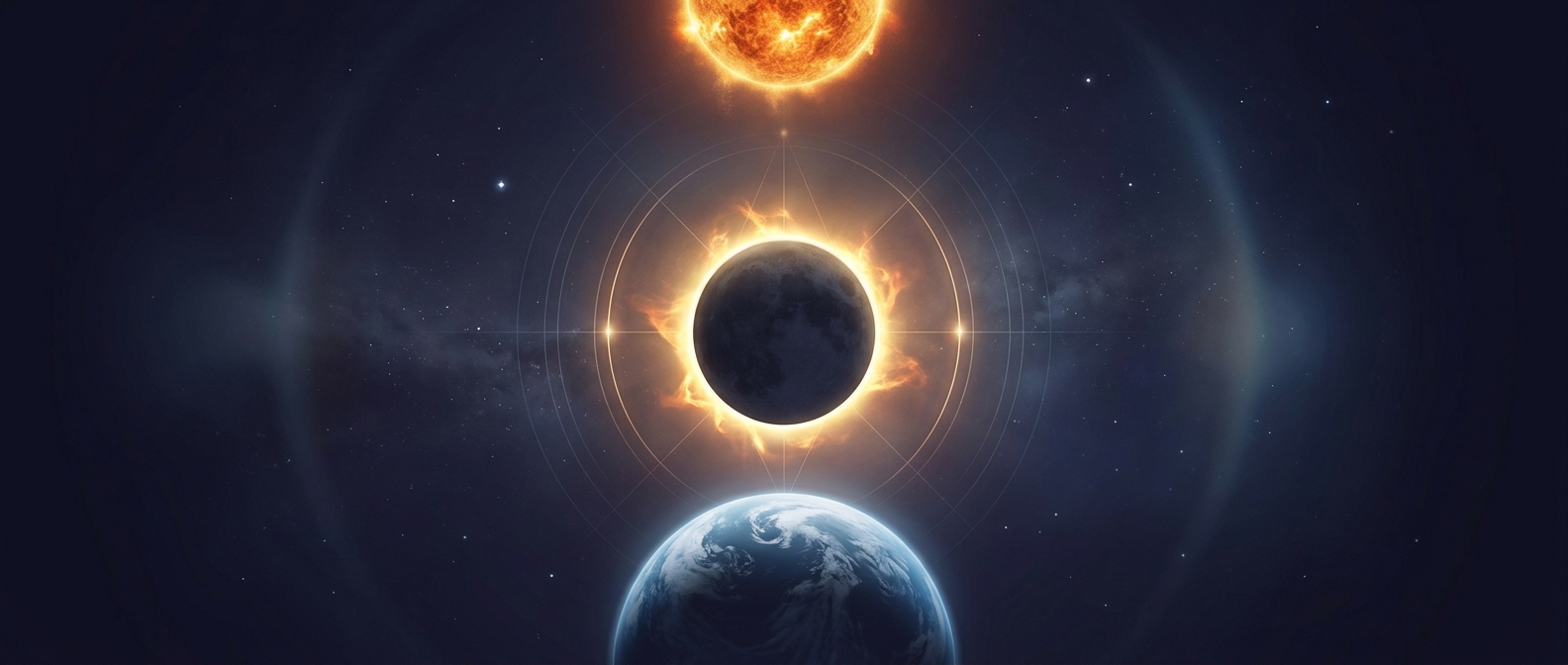
A total eclipse is possible because the Sun, though vastly larger than the Moon, is also much farther away. What matters from Earth is apparent size: the angle an object seems to span in the sky. The Moon’s apparent size can just match or exceed the Sun’s, letting it hide the bright disk completely.
That match is close, not fixed. Both orbits are slightly oval, so the Moon’s distance from Earth and Earth’s distance from the Sun vary. When the Moon appears smaller than the Sun during an eclipse, it leaves a bright ring around its silhouette; that is an annular eclipse, not a total one.
The slow change in the match
The Moon is gradually moving away from Earth. The cause is a tidal exchange: the Moon raises tides on Earth, and Earth’s rotation carries those bulges slightly ahead of the Moon. Their gravity pulls the Moon forward, adding energy to its orbit and nudging it outward. The exchange also very gradually slows Earth’s rotation.
As the Moon’s distance increases, its apparent size decreases. Eventually, even when the Moon passes directly in front of the Sun, it will appear too small to cover the whole solar disk. Eclipses can still occur, but the Moon will leave a ring of sunlight rather than produce totality.
A temporary celestial coincidence
Today’s total eclipses depend on a fortunate-looking size match, not on the Moon physically blocking the Sun everywhere. The Moon’s shadow reaches only a narrow track across Earth; observers outside it see a partial eclipse or none at all. The receding Moon makes the total-eclipse era temporary on astronomical timescales—so a total eclipse is both a precise alignment and a fleeting feature of the Earth–Moon system.