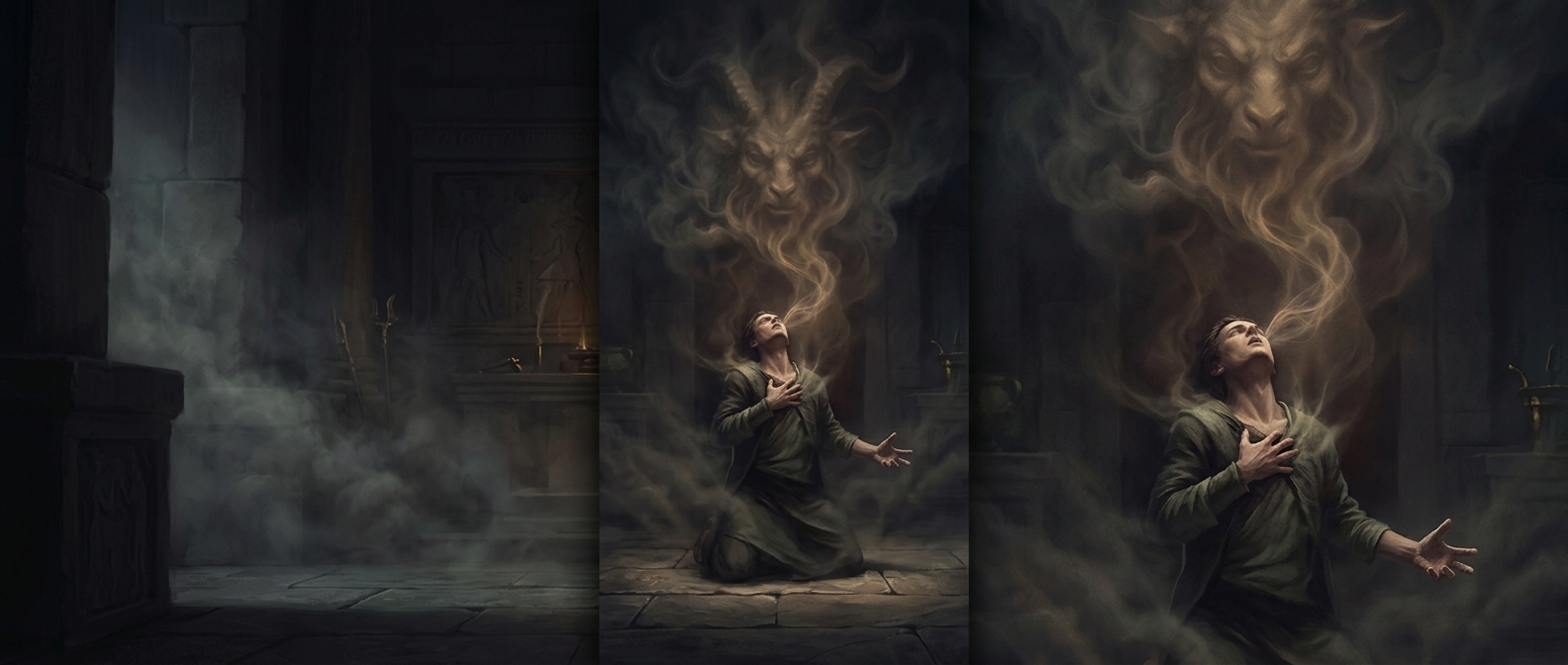
Breathlessness as part of the invocation
Aleister Crowley’s poem to Pan was not meant simply to be read as a piece of verse. In the ritual described in the caption, recitation continued until the speaker became breathless and an asthma attack began. The body’s distress was built into the performance: the invocation was meant to become a physical ordeal, not just a spoken appeal to a deity.
Asthma can narrow the airways, making it difficult to move air in and out of the lungs. Breathlessness is therefore not a dependable or harmless ritual effect; it signals a potentially serious medical episode. Crowley’s instruction treated that involuntary bodily response as part of the rite’s intensity.
A poem used as ritual action
In ceremonial magic, an invocation is an act of calling upon or identifying with a divine figure. Here, the poem’s repeated recitation supplied the action, while mounting breathlessness marked a change in the participant’s physical state. Pan, a figure associated in ancient mythology with wild nature, gave the rite its focus; the poem served as a means of addressing him.
The striking detail is the ritual’s dependence on a participant’s asthma: a private medical vulnerability became part of the ceremony’s design. That turns the poem from something merely heard into something enacted through the speaker’s breathing.