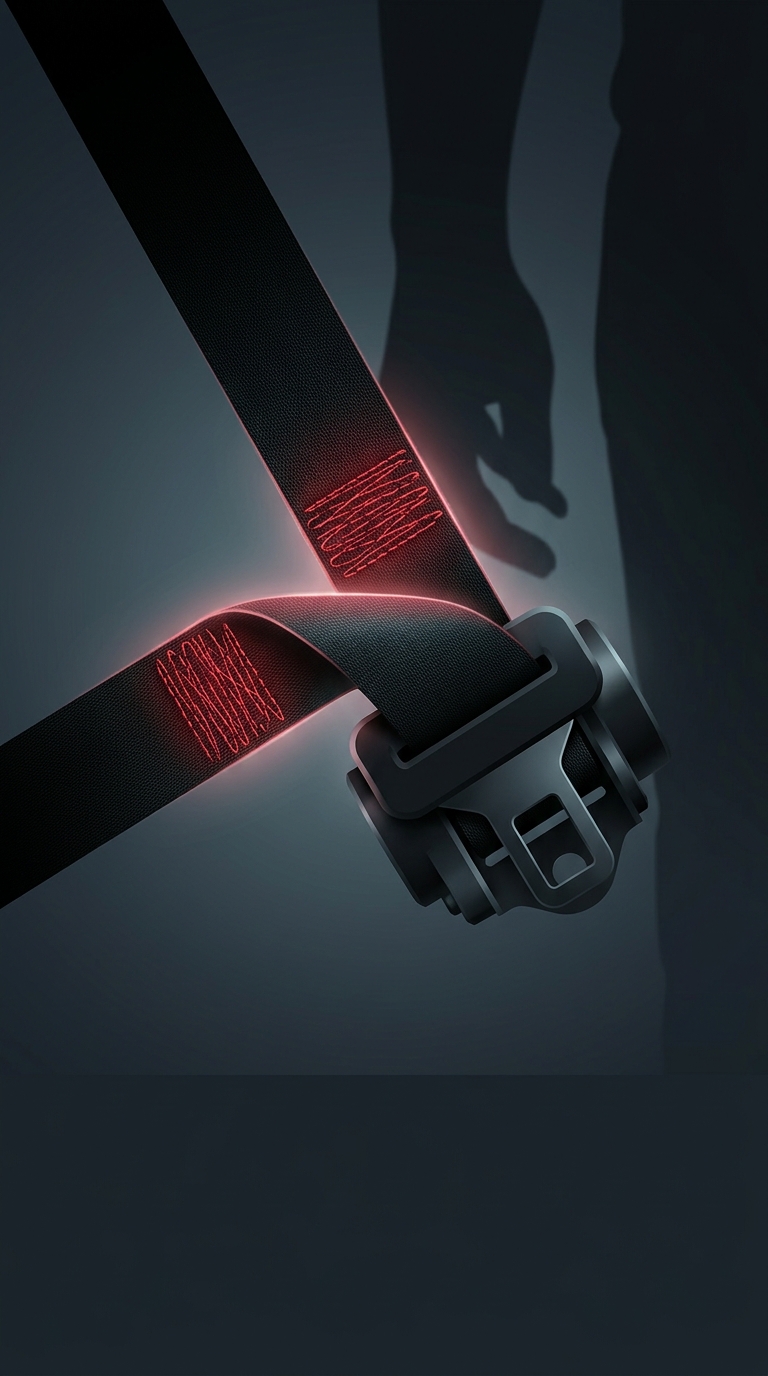
A stitched loop that can yield in a crash
That thick fold is often an energy-management loop: extra seat-belt webbing folded back on itself and held by stitching meant to tear under a sufficiently high load. In an ordinary stop, the stitches stay intact and the belt behaves like a continuous strap. In a severe crash, the belt’s force can pull the folded layers apart, making the webbing feed out a little at a controlled rate.
Why let a seat belt stretch?
A belt must restrain a person, but stopping the body almost instantly can create very high forces where the belt bears against it. As the stitches give way, the loop allows a small amount of additional belt movement. That controlled payout absorbs some crash energy and can soften the restraint force on the body.
The loop is not meant to come apart in routine driving, nor is it a device for adjusting belt fit. Its behavior is engineered as part of the restraint system: the belt must still hold the occupant while yielding in a severe impact. Other components, such as a retracting seat-belt mechanism, may also manage belt force, depending on the vehicle and belt design.
Leave the stitching alone
Because the folded webbing is designed to behave in a particular way under load, cutting, unpicking, or repairing its stitching can change how the belt performs. A belt that has been damaged or has been heavily loaded in a crash should be inspected or replaced according to the vehicle maker’s instructions. The small loop is not decorative—it is a carefully placed point where the belt may give way so the occupant does not have to absorb the entire stop at once.