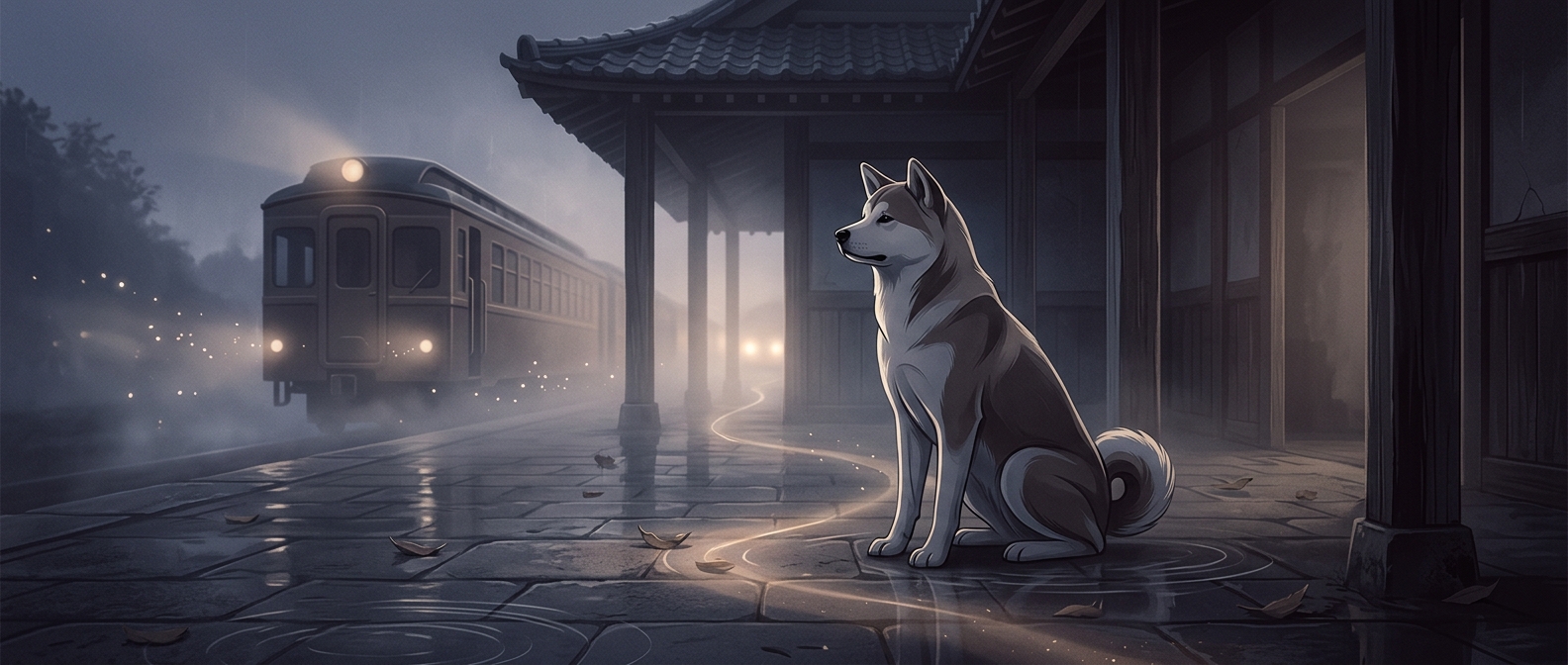
A familiar routine became a public story
Hachiko was an Akita dog whose daily life had revolved around a simple pattern: accompany his owner, University of Tokyo professor Hidesaburo Ueno, to Shibuya Station, then meet him there when he returned. Ueno died suddenly in 1925, but the station remained part of Hachiko’s routine. In a busy public place, his repeated appearances gradually became familiar to people who worked and traveled there.
The story might have stayed a local observation. Instead, a newspaper account in 1932 brought Hachiko’s behavior to a much wider audience. Readers saw more than a dog at a station: they saw a vivid expression of loyalty made visible through an ordinary daily habit. That interpretation helped turn Hachiko into a national symbol.
From station regular to memorial
A statue of Hachiko was erected near Shibuya Station in 1934, while he was still alive. Its location connected the memorial to the place where the story had unfolded—not to an abstract idea of devotion, but to a real meeting point in the city. Hachiko died the following year.
The statue was later lost during World War II, and a replacement was installed in 1948. The station-side meeting place remained part of the memorial’s meaning: generations of visitors could encounter the story where Hachiko’s routine had made it public. What began as a repeated journey between home and a railway platform became a lasting feature of Shibuya’s landscape.