Gutai turned the act of making into the artwork
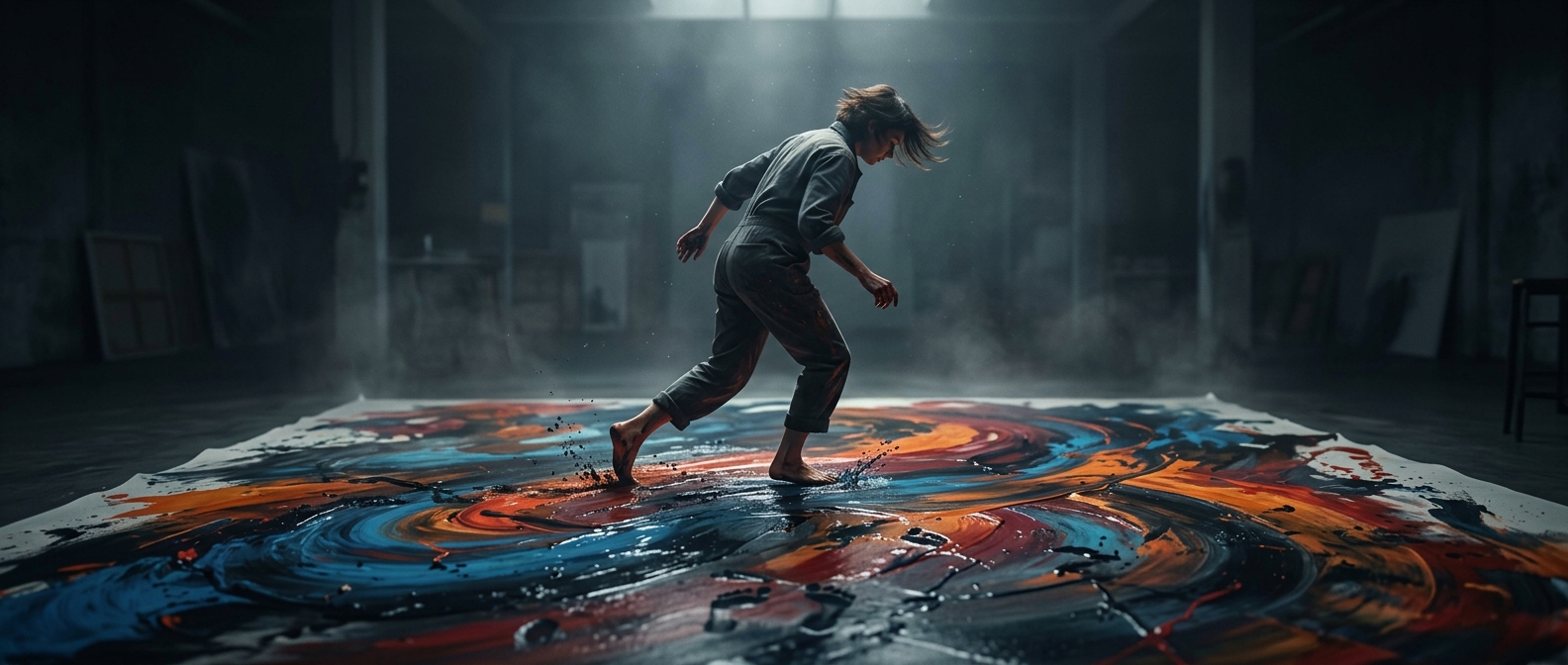
For the Gutai group in postwar Japan, a painting did not have to be a finished image hanging quietly on a wall. The artist could make the act itself the work: tearing, striking, or moving through a material, with the result unfolding in real time.
That shift changed what counted as art. A canvas usually keeps the artist’s gestures at a remove; viewers see their traces afterward. In Gutai performances, the artist’s body met the material directly, and the audience watched an encounter that could not be reduced to a picture of it.
Paper and mud made different kinds of events
Saburo Murakami’s Passing Through sent him crashing through a series of paper screens. The paper was not merely a surface to decorate. His body broke it, turning the action into a sudden passage from one side to the other—and leaving torn sheets as evidence of what had happened.
Kazuo Shiraga’s Challenging Mud used a heavier, less orderly material. Shiraga wrestled in a mound of mud, making bodily effort and resistance central to the performance. The mud was both the setting and the substance being worked; its shifting surface registered the struggle rather than receiving a carefully controlled brushstroke.
The work did not end with the performance
These actions made the artist’s presence impossible to separate from the art. They also left physical remains—damaged paper, disturbed mud—that could be seen after the movement stopped. But those remains could not fully reproduce the event: the force of passing through a barrier or wrestling with resistant ground belonged to the moment itself.
Gutai’s lasting provocation was to ask whether art had to be a durable object at all. In these works, the tear in the paper was not just an image of an action. It was the material consequence of an artist’s body passing through it.