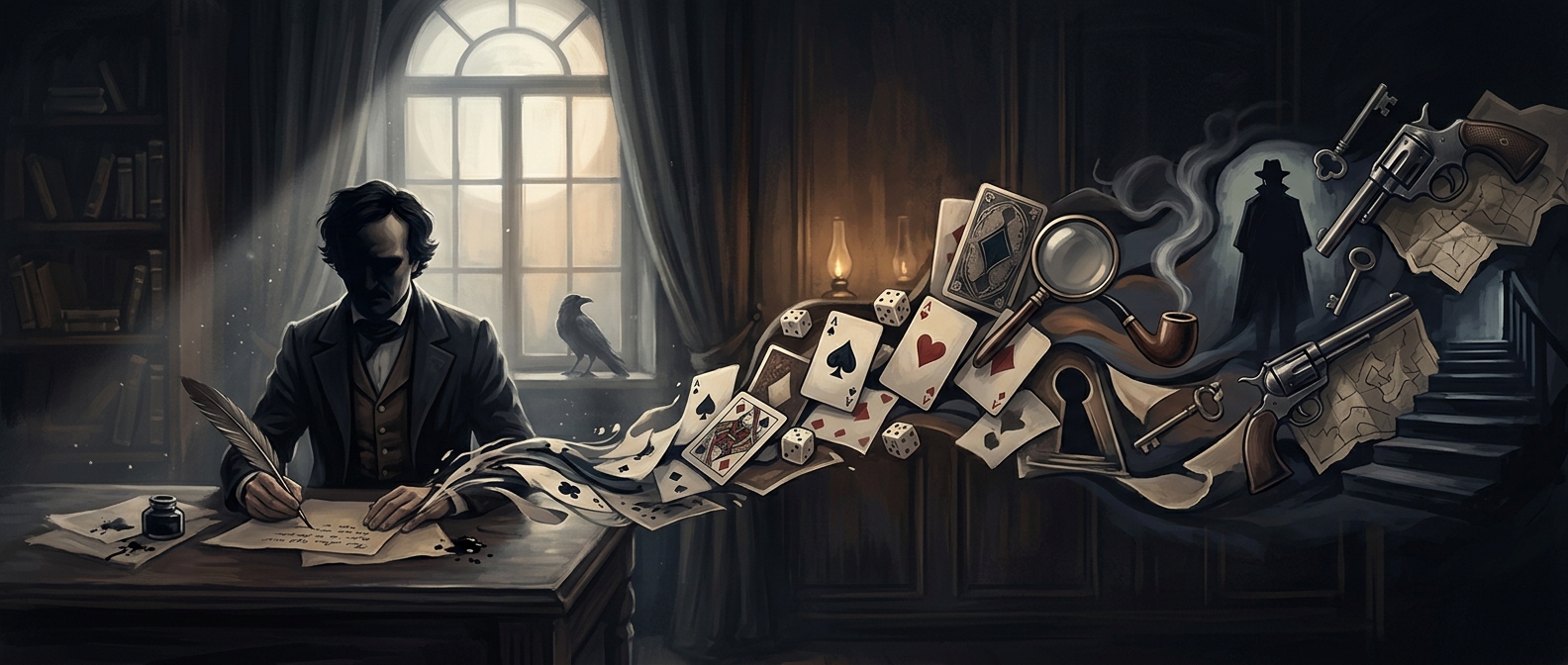
A mystery built around reasoning
In “The Murders in the Rue Morgue,” Poe made the detective’s mind the story’s main instrument. C. Auguste Dupin is not a police officer following a routine investigation. He is an observant outsider who reconstructs events by noticing what witnesses and officials overlook, then testing what those details imply.
The story gives readers the same puzzle: a brutal crime, conflicting testimony, and clues that seem impossible to reconcile. Dupin’s explanation turns those scattered details into a coherent account. The pleasure comes not only from learning who did it, but from seeing how careful reasoning can make an apparently baffling case legible.
A form later writers could reuse
Poe’s design supplied a durable pattern: an unusual crime, a capable investigator, a narrator who cannot match the investigator’s insight, and a final explanation that reorders the evidence. The narrator matters because readers discover the solution alongside someone who is clever enough to follow Dupin, but not clever enough to get there first.
Poe returned to Dupin in two later stories, developing the character across different kinds of puzzles. The model also traveled beyond Poe’s work. Arthur Conan Doyle later acknowledged Dupin as an influence on Sherlock Holmes, whose cases likewise turn observation and deduction into drama.
The magazine behind the invention
A magazine story had to earn its place in a periodical, and Poe was paid for his contribution. That commercial setting helps explain why a compact, suspenseful puzzle was a useful form: it could hold a reader’s attention through a sequence of clues and deliver a satisfying resolution within a single story. The paycheck was immediate; the larger consequence was a template other writers could adapt. Detective fiction would make the act of solving—not merely the crime itself—a central source of suspense.